
Looking for more? 

We’re just an email away.

CrowdFarming

7 min

Published June 2026

Statutes of 1% for the Soil

The rules governing 1% for the Soil

Anyone can join 1% for the Soil for free and closely follow the transition we finance. But before inviting you in, we believe you deserve to know how this works internally: where the money comes from, what it’s spent on, who decides, and what we consider a success.

These statutes are not a legal contract. They are the pact of a group of people who believe that European soil can and must regenerate, and that this regeneration depends on the decisions we make today. They define why the program exists, where the money comes from, what it’s spent on, how decisions are made, and what we understand by success.

I. Why We Exist

CrowdFarming’s mission: To make regenerative organic farming possible for farmers and accessible for consumers.

Soil is the planet’s most potential and undervalued resource, even though our subsistence depends on it. Decades of intensive farming have degraded 60% of European soil. More than 40 crops have lost up to 38% of their key nutrients since the 1950s. And the food system is responsible for over 30% of global greenhouse gas emissions, when it could be sequestering that carbon in the soil, making it more fertile and producing more nutritious food.

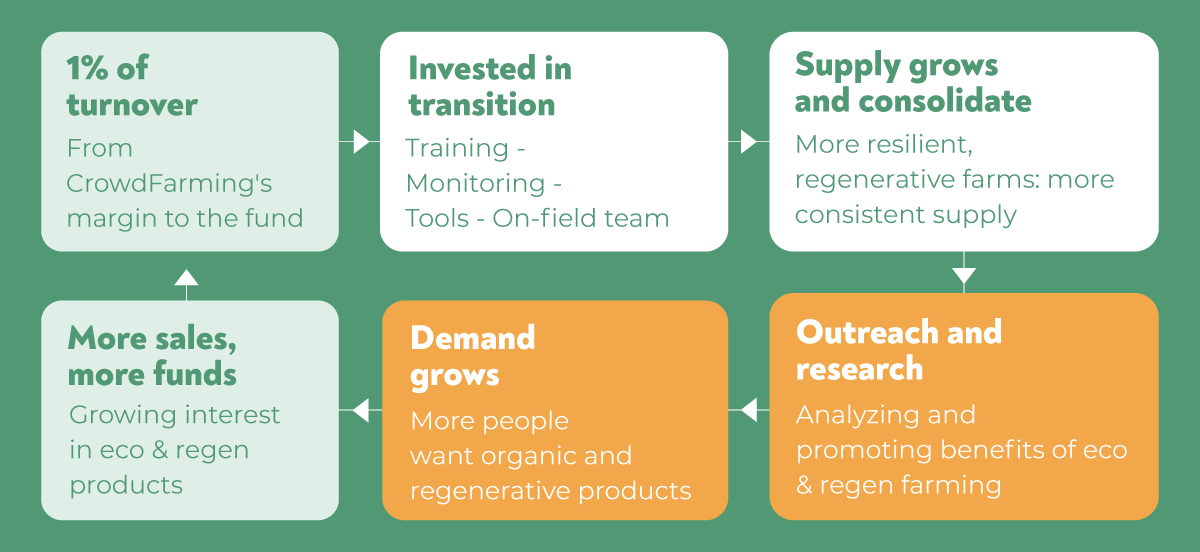
Given this, CrowdFarming decided in 2024 to allocate 1% of all gross revenue generated by its organic and regenerative farms to directly finance the transition.

The program focuses on growing the supply: ensuring there are more and more certified organic farmers regenerating their farm ecosystems, starting with the soil. This is the lever we act upon, because without sufficient supply, demand has nothing to sustain itself. It is also essential to grow demand, so that it is safer for the next farmer to take the step. The fund not only finances those starting the transition: it also supports those already producing regeneratively, because regeneration is not a goal, but a work of continuous improvement.

II. Where the Money Comes From

The fund is nourished by 1% of the gross revenue from CrowdFarming’s regenerative and converting-to-regenerative farms. Without raising prices. Without cutting farmers’ income. It comes from CrowdFarming’s margin, because we believe a resilient future is worth more than immediate profitability.

The 1% is a guaranteed minimum, not a ceiling. The fund is cumulative and can close a period with a surplus or deficit. In fact, CrowdFarming usually invests above that 1%: since its launch, 71% of what has been executed has come from the 1% for the Soil fund, and the remaining 29% has been complemented directly by CrowdFarming, exceeding its commitment.

The objective of this financing is not to subsidize the farmer or become recurring aid on which they depend to sustain their farm. The fund does not give money to the farmer: it finances on-farm results monitoring, training in regenerative techniques, and support to convert that data into decisions through management tools. It is the impetus that allows them to demonstrate that the model works and then sustain it themselves.
III. Who Is Part of It

Today, 1% for the Soil has a single type of member. Anyone can sign up, whether or not they are a CrowdFarming user. Being a member grants access to information about the program’s progress: funded projects, farms in transition, soil and nutrition results, and a full breakdown of how the fund is distributed, which we publish every six months.

Among members, we seek diversity of perspectives, not uniformity of values: from those who work within large agribusiness companies to those who have been criticizing them from outside for decades; from the agronomist with field data to the consumer who has been asking the right questions for years.

IV. How Initiatives Are Decided

The initiatives financed by the fund are decided through a jury and a fixed calendar, not discretionally.

The program operates in two semi-annual cycles per year, deliberately staggered with respect to the accounting close so that the jury votes with real budget figures on the table, not estimates. Proposals are submitted throughout the cycle following a common template: specific problem they solve, who implements them, geography and scale, itemized budget, 12-month success metrics, and potential conflicts of interest.

Before each decision, proposals that meet the minimum criteria are debated in the community space. This debate informs the jury’s assessment, which meets semi-annually and votes on what is funded. Each decision and its reasoning are recorded and shared with the community.

Today, the jury consists of three people: Juliette Simonin (CrowdFarming co-founder), Cristina Domecq (1% for the Soil director), and Yanniek Schoonhoven (farmer and founder of Regeneration Academy), who brings the perspective of someone in the field. Additionally, we will create an ad-hoc advisory committee to guide us from different perspectives and broaden our horizons.

V. What the Fund Invests In

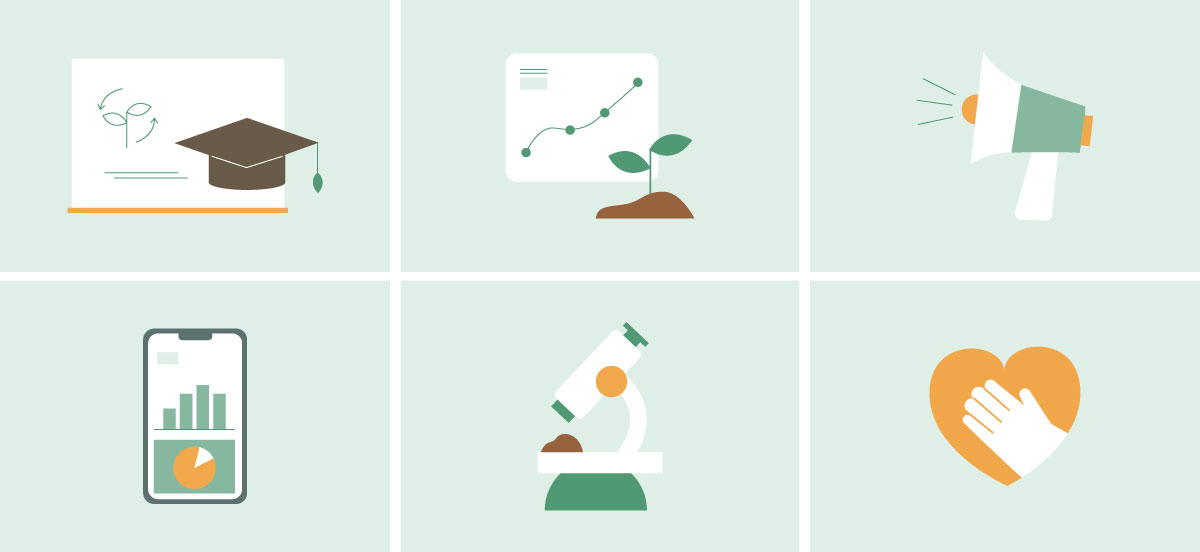
Resources are distributed across six categories:

  • Training. Technical support, on-site and online: field events, continuous mentoring sessions, and connection between farmers with common goals.
  • Monitoring. Measurement of on-farm results (soil, water, biodiversity, carbon, animal welfare, and social impact) to convert data into information for better decision-making.
  • Dissemination. Promoting the model and its results so that demand grows at the pace of supply.
  • Tools. Digital tools that optimize the farmer’s work and help them plan the transition, so they can focus on soil health and product quality instead of administrative tasks.
  • Research. Scientific evidence to open institutional doors, validate the model, and transform collective thinking.
  • Team. The people who execute the program on the ground: the agronomists who train and monitor, and the team that coordinates the fund and supports farmers. This is not an administrative cost: it is what makes everything else possible: the labor that converts fund money into training, measurements, and real on-farm follow-up.
How it has been distributed since its creation

Since its launch on July 1, 2024, we have invested €517,637 in the regenerative transition (including team dedication). We publish the full financial breakdown every six months.

Category % Invested since 07/01/2024
Training 10% €51,764
Monitoring 8% €41,411
Dissemination 13% €67,293
Tools 9% €46,587
Research 0% €0
Team 60% €310,582
Total 100% €517,637

Research does not yet appear as a direct fund expense in this period, but it is not an inactive line: we have dedicated team time to launch it, and in H1 2026 we will already have our first own data.

VI. What We Understand by Success

The success of 1% for the Soil is measured on two mutually supportive levels: impact in the field and community strength.

In the field, our first North Star was to transition 10,000 hectares of European land to regenerative systems. By the end of 2025, 4,176 hectares were in active transition and 53 farmers were in the official program, and as we approach that goal in mid-2026, we have decided to extend the commitment: to perpetuate the fund until 25,000 hectares are in regenerative transition.

In the community, success is bringing together and keeping active the largest European community that debates and decides on the future of regenerative agriculture, and ensuring that community truly participates in the fund’s decisions.

Goals per year:

Year Field Community
2024 Fund launch (July) · first monitored farms Community establishment
2025 4,176 ha in transition · 53 farmers · €517,637 invested (cumulative) 3,319 active members
2026 100+ farmers and progress towards 10,000 ha (June) 15,000 active members
2030 25,000 ha in transition 50,000 active members

VII. Amendment of these Statutes

Any substantial change will be communicated to members at least 30 days in advance by email and/or agreed communication channels, such as the community space.

This is 1% for the Soil from the inside. If you’ve made it this far, you’re probably already one of the people European soil needs. Join 1% for the Soil.

Written by Cristina Domecq
Cristina Domecq

Cristina Domecq is the Head of Impact at CrowdFarming. She operates where the boardroom, the field, and social conversations converge, convinced that the clues to fixing the food system are revealed in that intersection. Her goal is to achieve a behaviour change that sticks—a mission that only works if both farmers and consumers are truly on board.

Comments

Your email address will not be published.

Share this content:

Keep digging ...

CrowdFarming

9 min

The “why meat” question

The path to a truly regenerative agricultural system often unfolds in unexpected ways. For many of our organic farmers, the journey began with the adoption of cover crops – plants grown not primarily for harvest, but to protect and enrich the soil. However, managing these cover crops, especially in complex landscapes like the terraced avocado groves of Southern Spain or the undulating terrain of vineyards where machinery access is limited, presented a new challenge. It was in seeking solutions that these farmers rediscovered an ancient ally: livestock.Animals, they found, were remarkably adept at managing these “weeds” and cover crops. But the benefits didn’t stop there. The integration of livestock brought with it a cascade of positive ecological effects. Their manure provides a natural source of fertiliser, rich in nutrients and organic matter, steadily improving soil health. The gentle disturbance of their hooves can help to break up compacted soil surfaces and tread seeds into the ground, aiding germination and plant diversity. As they graze, they trample plant matter, creating a natural mulch that protects the soil from erosion and helps retain moisture. Furthermore, animals can carry seeds in their coats and digestive tracts, contributing to the dispersal of plant species and enhancing biodiversity – a process known as zoochory. In essence, livestock became active partners in regenerating the land, contributing not only to soil health but also supporting greater biodiversity, including vital pollinators feeding on diverse pastures and increased soil microbe and earthworm populations benefiting from organic matter cycling.This rediscovery, however, highlighted another pressing issue: the scarcity of shepherds and skilled livestock managers. For generations, shepherds were the stewards of the land, guiding their flocks in a way that benefited both animals and ecosystems. Yet, a confluence of factors – including the rise of intensive farming systems, challenging economic returns from traditional sheep and goat products, the demanding lifestyle, shifting land use policies, and an ageing rural population – has led to a sharp decline in their numbers. This presented a quandary. How could we, at CrowdFarming, encourage the vital integration of livestock into regenerative systems if the very people skilled in managing them were disappearing? Or, if farm managers took on herd management themselves, how could we ignore a potential avenue to support their livelihoods, especially when it aligns so seamlessly with our model of direct connection?However, these pioneering farmers often face considerable challenges. They navigate the competitive pressures of intensive farming, the financial investment required for organic certification, and restricted access to markets that genuinely recognise and reward their dedication to superior environmental and animal welfare standards.These experiences and observations have culminated in a new step for CrowdFarming. Driven by our commitment to supporting farmers who are at the forefront of regenerative and organic practices, we are introducing responsibly sourced meat products as an evolution of our current model. By creating a stable and direct sales channel, we aim to bolster the economic viability of these farmers, supporting their transition towards, or their ability to continue, these regenerative and organic farming systems.And we are taking this step after much reflection and debate. Debate both internal and external, with people who support us in this decision and others who would have preferred we didn’t make it. I want to extend a special thanks to the group of vegans working at CrowdFarming for engaging in such constructive discussions and for presenting a well-reasoned perspective.This is a matured decision that we are making resolutely, convinced that moderate consumption of meat from farmers who share our values can help us build a more sustainable food supply chain.Who makes the cutThe producers participating in this new initiative will be certified organic (or in the process of converting to organic certification), their animals will be predominantly pasture-fed, and the farms will be actively implementing measurable regenerative agricultural practices.For those unfamiliar with the terminology, it is important to clarify these terms: Organic Farming: Within the European Union, stringent regulations govern organic farming. These mandate that animals are predominantly reared outdoors with ample space, receive feed from organic sources, and that the use of genetically modified organisms (GMOs) is prohibited. Furthermore, there are strict limitations on the application of antibiotics and other veterinary treatments. These organic principles, combined with our pasture-feeding requirements, inherently exclude intensive practices such as continuous indoor confinement or feedlot finishing. Pasture-Fed: A significant portion of the EU’s organic agricultural land, approximately 44%, consists of permanent pasture. If this pasture is managed regeneratively, the opportunity to generate a positive impact on the environment is considerable. For herbivorous animals (e.g., cattle, sheep) in this initiative, their diet will consist of 100% grass and forage from these pastures. For omnivorous animals (e.g., pigs), a minimum of 70% of their diet will be pasture-based, with the remainder being certified organic supplementary feed. Crucially, the definition of pasture and forage under these standards excludes common intensive feed ingredients like grains (maize, wheat, barley), soya meal, grain legumes (peas, beans), and specific industrial by-products. For CrowdFarming, this represents a commitment beyond standard organic practices, focusing on actively improving the farm ecosystem. It describes a holistic approach where the primary focus is restoring and enhancing soil health, increasing biodiversity, and improving water cycles. Livestock farmers participating in this initiative adhere to organic principles (or are in conversion), meet our pasture-fed standards, and follow the Measurement, Reporting, and Verification (MRV) protocol of CrowdFarming’s Regenerative Agriculture Program. This ensures practices lead to quantifiable positive outcomes, which are monitored and made public through our Regeneration Index. Key practices often include rotational grazing, which mimics the natural movement of wild herds allowing pastures periods of rest and recovery, preventing overgrazing and promoting soil regeneration, as well as fostering diverse pastures.   Transparency is an unwavering principle at the heart of the CrowdFarming model. The authenticity of the farming practices for this new meat offering will be assured through several robust layers of verification: The official EU organic certification. An internal protocol, overseen by our agronomic teams, to ensure adherence to minimum levels of pasture-feeding. The Monitoring, Reporting, and Verification (MRV) framework integral to CrowdFarming’s Regeneration Index. Clearing the air: Methane, CO2 and N2OConversations about livestock farming inevitably involve greenhouse gases, and some of the first arguments often include cows’ burps (against) or the ability of pastures to sequester carbon (for). It’s not as black and white, and it’s crucial to address this openly and accurately.Methane: Ruminant animals produce methane through digestion. Unlike carbon dioxide (CO2), which persists and accumulates in the atmosphere for centuries, methane is a potent but “short-lived” gas, breaking down in about 10–12 years: which means it doesn’t have the same warming effect as CO2. While global methane levels require significant reduction across all sectors (including fossil fuels and landfill), climate science indicates that eliminating agricultural methane entirely isn’t necessary to stabilise temperatures. Strategies compatible with pasture-based systems, such as improving animal health, selective breeding for lower emissions, and potentially optimising forage diversity, offer pathways for sustainable reduction.  Carbon Sequestration: Well-managed grasslands and integrated systems with trees (agroforestry) have the potential to draw down CO2 from the atmosphere and store it as carbon in soils and biomass. While the exact amount and long-term permanence of sequestration is complex and varies greatly depending on soil type, climate, and management history, focusing on these practices contributes positively to soil health and ecosystem resilience, even beyond the carbon benefit. CrowdFarming focuses on verifying these practices known to build soil health, rather than making specific farm-level carbon negativity claims, which remain challenging to substantiate definitively year-on-year.  Nitrous Oxide (N2O): A long-lived and potent greenhouse gas, N2O emissions in agriculture are strongly linked to the use of synthetic nitrogen fertilisers and manure management. By requiring organic certification (eliminating synthetic fertilisers) and favouring pasture-based systems (reducing manure concentration), our approach inherently lowers N2O risks compared to intensive models. Furthermore, integrating nitrogen-fixing legumes like clover into pastures can significantly reduce or eliminate the need for external nitrogen inputs, further mitigating N2O emissions.Offering a better alternativeThis initiative extends beyond merely introducing a new product category. Its core purpose is to provide tangible economic support to farmers who are leading the charge in ecological and regenerative livestock systems. By establishing this direct channel, we aim to furnish them with a degree of predictable income, thereby strengthening their financial stability and enhancing their capacity to maintain and expand practices that yield substantial benefits for our shared ecosystems.We understand and respect that individuals choose vegetarian or vegan lifestyles for a variety of environmental and ethical reasons, and there’s many of us in CrowdFarming following this way of life. Indeed, major scientific bodies like the Intergovernmental Panel on Climate Change (IPCC) have highlighted that shifts towards balanced diets, including a reduction in the overall consumption of animal-sourced foods – particularly those from high-emission systems – can contribute significantly to mitigating greenhouse gas emissions and lessening environmental pressures. However, many people continue to include animal products in their diet and are actively seeking high-quality meat that aligns with their values regarding animal welfare and environmental stewardship. This search for quality is supported by research indicating nutritional differences in the resulting meat and dairy. Studies have shown that products from animals raised predominantly on pasture, compared to those fed grain-concentrate diets, tend to have higher levels of beneficial omega-3 fatty acids, a more favourable omega-6 to omega-3 ratio, higher levels of conjugated linoleic acid (CLA), and higher concentrations of certain vitamins like E and some B vitamins. For these consumers, finding and verifying products from farmers employing robust organic, pasture fed and truly regenerative methods often remains a significant hurdle.We view this initiative as a significant opportunity to raise awareness among consumers about the positive impacts of well-managed, integrated livestock within regenerative organic agriculture. It also serves to highlight the distinction between these farming models and other systems that can have more detrimental environmental and animal welfare outcomes. We are convinced that by fostering a deeper understanding and providing direct access to these thoughtfully produced products, we can play a part in encouraging more farmers to embrace these beneficial philosophies of land stewardship. It also empowers consumers to make informed decisions about the origin and production methods of their food.This expansion is a carefully considered evolution for CrowdFarming, reinforcing our unwavering commitment to forging an agri-food chain that is more fair, sustainable and resilient. By providing direct access to meat from farms adhering to these rigorous organic, pasture-fed, and verified regenerative standards, we empower consumers to make informed choices that directly support farmers investing in animal welfare and ecosystem health. We are enthusiastic about embarking on this new chapter with our community of consumers and farmers.

Read