
Looking for more? 

We’re just an email away.

Field news

2 min

Published October 2026

The next generation takes the reins in Sicily

This is my second time catching up with Renato from BioAgrumi Monasteri in his Sicilian citrus groves. For me, it feels just like coming home. It’s probably partly because Renato speaks German, but it’s also down to his warmth: a “Buongiorno” from him is as heart-warming as the sun over Etna.

This visit was particularly special, as we put together an online course on Sicilian citrus farming. Click here to discover the challenges Renato faces and the deep-rooted love for Berlin that connects him to Germany. Back in 1998, the farm became the first certified organic citrus estate in the region, and last year Renato even managed to achieve Demeter certification. This focus on soil biology and biodiversity is built on decades of organic work—a true passion project started by Renato’s father, Angelo.

Renato lived in Berlin for five years before deciding to take over the family business. “My father is over the moon with my decision,” he tells me when I bring it up. More and more farms in the area are folding because there’s no one to take over. “I hardly know any farmers my age, let alone anyone doing organic!” Not everyone is willing to take on so many challenges or the sheer weight of responsibility for the farm, the staff, and, of course, their own health. “My day starts at 4:30 am with a coffee and a bit of prep until the staff arrive at 6:00.” I check my watch: it’s 6:30 pm. “I’ll be here until at least 9:00 pm because we’ve got tomorrow’s orders to get ready, and there’s still cleaning to do,” Renato says.

One thing’s for sure: without that passion and a fair bit of grit, these hurdles would be impossible to clear.

Written by Magdalena Werner
Magdalena Werner

I'm Magdalena, a Farmer Ambassador. I've been working at CrowdFarming for eight years, and after seven years in customer service, I'm now part of the sustainability and awareness team, sharing the farmers' stories and taking you on a journey through their daily lives in the fields.

Comments

Your email address will not be published.

Share this content:

Keep digging ...

Field news

3 min

The ‘Mad German’ 40 Years On

If you take a stroll with Friedrich across his farm near Gibraleón today, the first thing you’ll notice is the noise: a literal wall of birdsong. But behind this idyllic scene lies a radical choice made years ago—one that flew right in the face of convention. Today, having held Demeter certification since 1994, he’s living proof that his “madness” was the only logical response to the crisis facing our soil.Forty years ago, Friedrich fell in love with Finca Jelanisol-Montebello during a trip to Spain. At the time, he was working as a middleman for conventional fruit and veg. Two things happened back then that made him stop and think: A friend gave him a book on permaculture by Bill Mollison, which sparked an idea. While visiting a farm in Italy, he found himself desperately digging for earthworms. When the farmer told him there weren’t any “because you don’t need them,” Friedrich began to question everything. A Holistic Vision: Everything is ConnectedFor Friedrich, farming isn’t an isolated job; it’s part of a much bigger picture. He holds a deeply philosophical, holistic view of the world where everything—from soil microbes to the end consumer—is linked. He doesn’t see his farm as just a production site, but as a living organism where people and nature live in harmony. In his eyes, a peaceful society can only exist if we produce in tune with nature. If we get it right, there’s enough for everyone—we just can’t afford to destroy the foundations.One of the biggest things driving Friedrich is a deep-seated worry about the state of the modern diet. He explains that much of the food we eat today is “empty.” By this, he means conventional produce that, thanks to pesticides and long storage times, has lost any real nutritional value. He lives by the rule: Healthy Soil = Healthy People. Only living, regenerated soil can produce fruit that actually nourishes the body.One of the first things Friedrich did was build a large pond—not for irrigation, but purely for the birds, frogs, ducks, and fish. It also acts as drainage during heavy rain. They produce their own organic fertiliser using microorganisms, supplying the trees with a steady stream of minerals through a drip irrigation system.

Read

Field news

min

The Science Behind the Sweetness

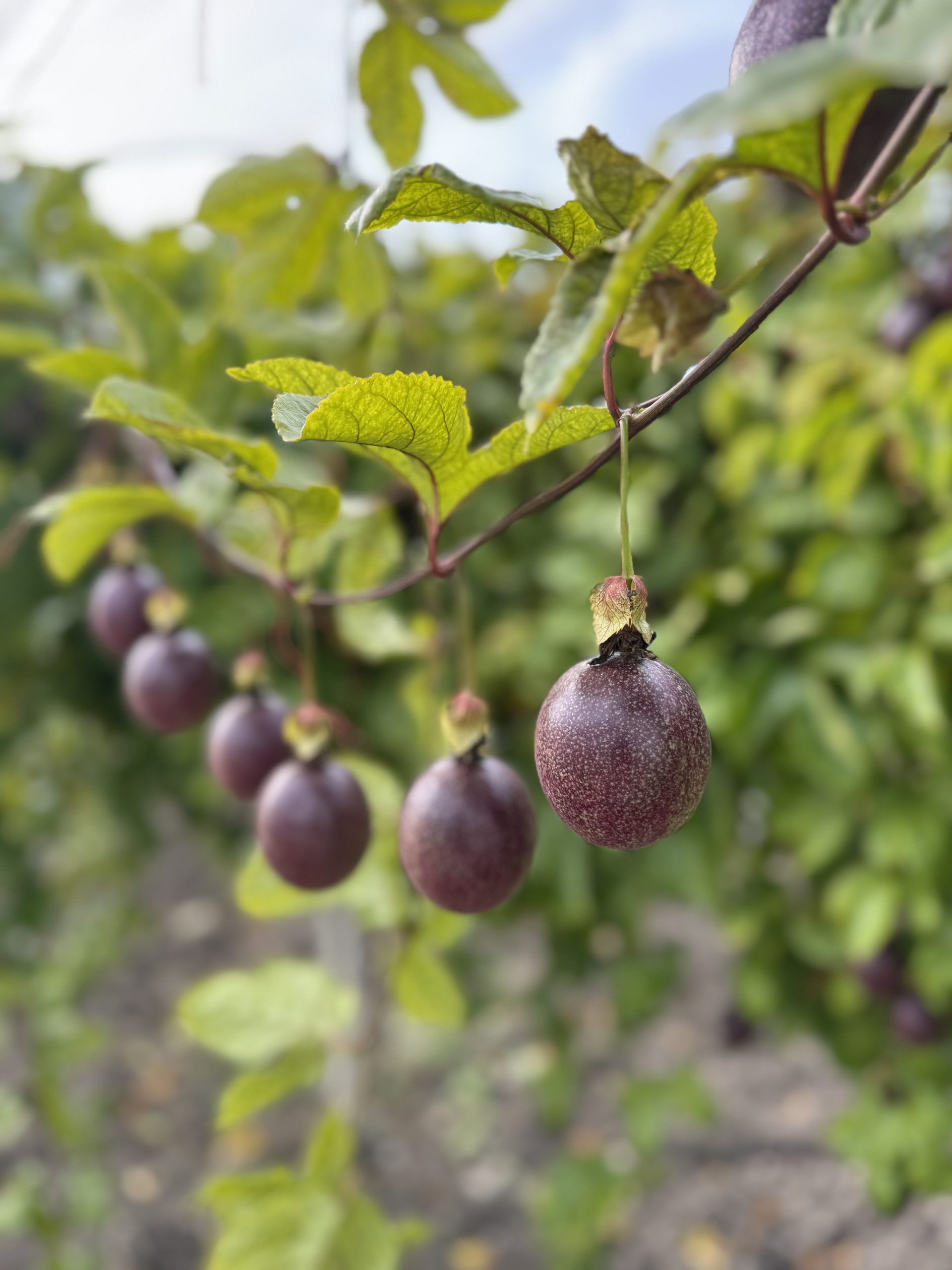
We visited Antonio from Sicilian Passion in Sicily. In a region traditionally known for its citrus fruits, Antonio decided to take a different path several years ago: he grows passion fruit (and even papayas!).Brix value, ensuring that the fruits have reached the required physiological maturity and full aromatic profile. Harvesting only begins once these thresholds are met. In the video below, you can see our colleague Angelo taking these measurements. It’s a lot of fun, because you’re literally looking into the future.Ripening Characteristics and EtymologyAn important quality characteristic of passion fruit is the texture of its skin. Unlike many fruits, here’s the rule: the more pronounced the wrinkling of the fruit, the higher the sugar content. Due to slight evaporation during the ripening process, the fruit sugar concentrates inside, while the acidity subtly decreases. There are two harvests per year – one in the winter months and one in the summer months. Especially in summer, the fruits are “wrinklier” because the liquid evaporates faster due to the heat.Did you know that the name “passion fruit” is derived from Christian iconography? Spanish missionaries in the 16th century interpreted the complex flower structure as symbols of the Passion of Christ. The filaments of the flower were associated with the crown of thorns, the three stigmas with the nails of the cross, and the five stamens with the wounds. In the gallery, you’ll find a picture where this is very clearly visible.

Read