
Published October 2026
Price transparency: How much does the farmer get paid?
A lot has changed since the beginning of CrowdFarming, but one thing that hasn’t changed is our values: Bravery, Innovation, Sustainability, and Humanity. We believe that price transparency fits into all of them.
- Being transparent about prices is brave: we’re open to sharing all the details and receiving your comments and questions. We know it is through this exchange that awareness is born.
- Being transparent about prices is innovative: there are not many examples of companies doing this in the industry, and this opacity is blocking progress.
- Being transparent about prices is sustainable: we need to acknowledge that if farmers’ economics don’t work, a sustainable transition is not possible.
- Being transparent about prices is, above all, human: we are in this business to make the agrofood supply chain a fair one. This means farmers must be recognized and paid fairly for their work.
So if you have ever asked yourself, “With CrowdFarming, how much does the farmer get paid? How is the price of the boxes calculated? How is my money distributed? How much is CrowdFarming getting?” you’re in the right place.
“300 farmers choose CrowdFarming as their sales channel because of what this means for their business and for their profession. With CrowdFarming they set the price, and are able to offer their produce to consumers, building a direct relationship of trust and commitment. It’s about a fair and sustainable income, of course, but it is also about the type of recognition that drives improvement”.
– Gonzalo Úrculo, co-founder and farmer at CrowdFarming
How are the prices are calculated at CrowdFarming
Price building in conventional channels
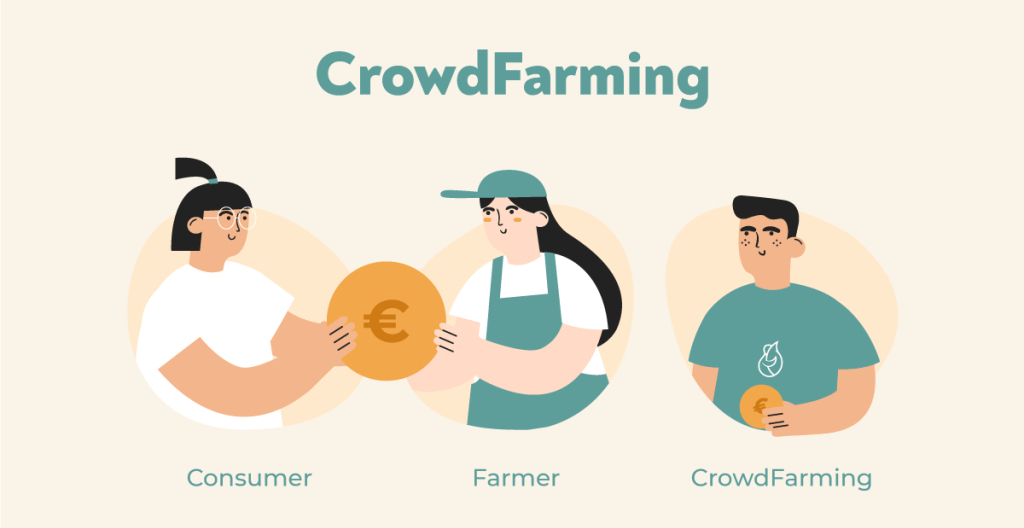
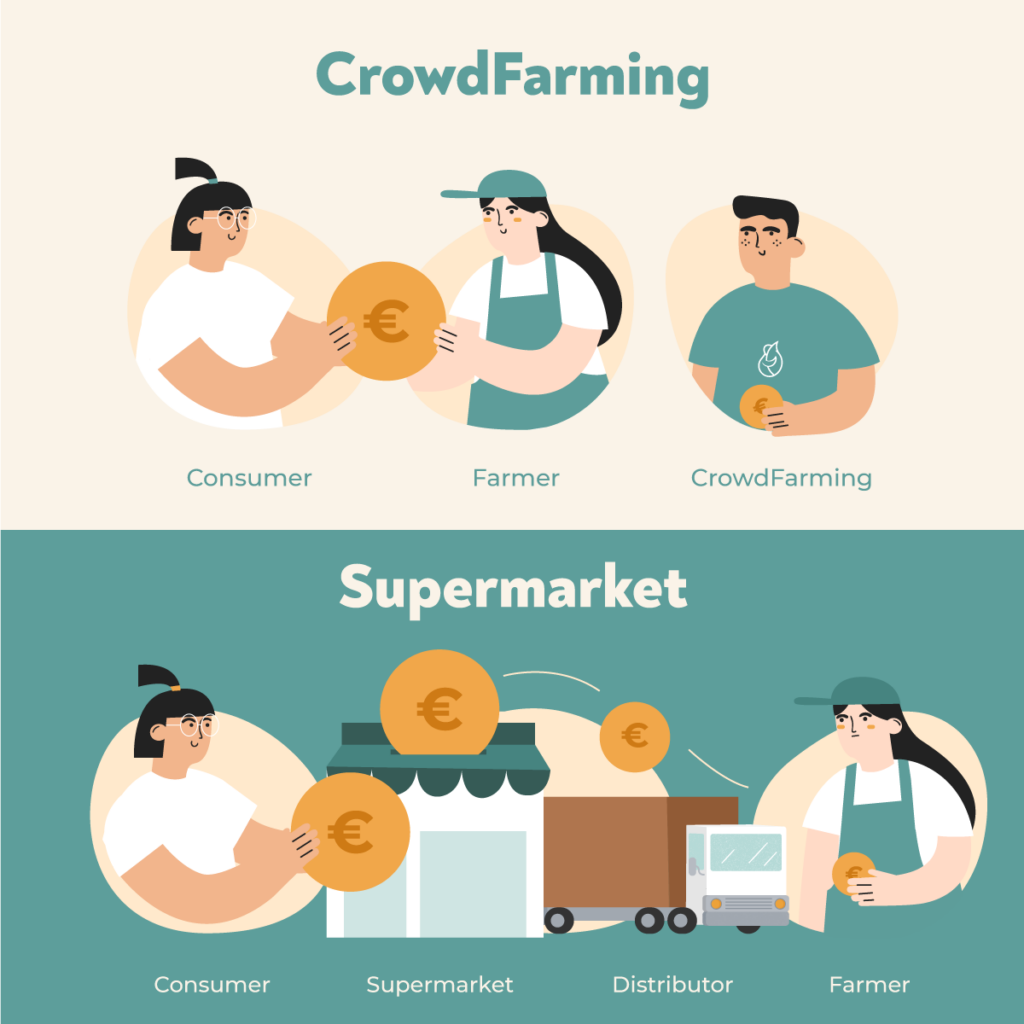
In conventional channels (like supermarkets) the prices are ruled by the commodity mechanics, where the farmers make estimations of the price at which they are going to be able to sell the produce based on last year’s prices — with the uncertainty, however, of external factors that will affect this year’s harvest. Because their income depends, mainly, on the amount of kilos produced, they will try to maximize production at any cost — many times with the help of agrochemicals.
When the harvest is ready, it’s time to negotiate the price with intermediaries and supermarkets, accompanied by sentences like “the increasing imports from Turkey, Morocco, or Chile have lowered the buying prices” while the produce continues to ripen, and the risk of losing it all increases. These are not fair terms to negotiate.
On top of this, the supermarket will set standards for the fruits they purchase (size calibre, shape restrictions, and overall so-called “perfection”) creating a lot of waste for the farmers who are therefore unable to sell all their harvest. The farmers sell the fruit to intermediaries who then sell it to supermarkets and have no idea where it’s going and who is buying it. A consumer will pick it up from the shelf without knowing who, how, when or where it was produced, and probably make something delicious with it, but the farmer will never know. The supermarket will then pay the farmers for their fruit up to 120 days after the sale.
This is a broken and unfair system, founded on speculation and instability, which directly impacts the price consumers pay (like we’ve seen with olive oil), the price farmers get, the amount of food waste generated, and even the taxes we pay: one third of the EU budget is used to keep this inefficient supply chain running.
How does a farmer sell his produce through CrowdFarming?
The most important thing to get out of this article is that, at CrowdFarming, the farmers set their own prices based on their own criteria. No matter the volume sold, destination country, or market volatility, the farmer will get the agreed price per kilo and CrowdFarming will assume the rest of the risks.
- CrowdFarming adds value by offering all the necessary services that farmers need to sell their harvest. Joining the CrowdFarming platform is free for farmers, they do not need to pay any fee. Our services just apply if they sell and are divided between logistics services, platform services and agronomist services.
- The price decided by the farmers at the beginning of the season sticks for the rest of the season, protecting the farmers from fluctuations and speculations of the conventional trade and allowing them to have a much more stable financial plan. This speculation found in conventional channels can drive farmers to artificially extend the season through ripening chambers or cold chambers in order to earn more at moments where the competition is lower.
How is the final price created?
After the farmer sets their own price, we calculate the final price that will appear on the platform.
Price per kilo set by the farmer, which the farmer gets entirely no matter how much is sold and no matter the destination.
- 22% as an average calculated based on the farmer price, for CrowdFarming services. To promote adoptions, CrowdFarming brings this fee down to 16%. For products with low production costs, CrowdFarming charges up to 32% to be able to absorb fixed costs.
- 1,5€ cost per transaction for secure payment methods (credit card, paypal, sepa etc) and anti-fraud systems.
- 3-4€ per box for picking and packing, including recycled packaging materials, dedicatory letters and transport labels.
- 25-30% calculated based on final consumer price, for transporting the order to the home address (depends on volume, origin, destination, transport provider)
- VAT depending on the country of destination
= Final price paid by the consumer at the destination country.
These percentages are averages of all products offered through CrowdFarming, this is why if we study a specific case, percentages may vary. Why is this? Let’s say we buy 4kg of oranges or 4kg of cheese, and both make the exact same journey, the only thing that changes is the price at origin set by the farmer. The costs of transaction, picking, and transport are the same, but the farmer price is lower in the citrus case (because it costs less to produce 1 kg of oranges than 1 kg of cheese); therefore, the proportion of the final price going to the citrus farmer will be lower in comparison to the proportion the dairy farmer gets.
By choosing CrowdFarming as a sales channel, what services does the farmer receive?
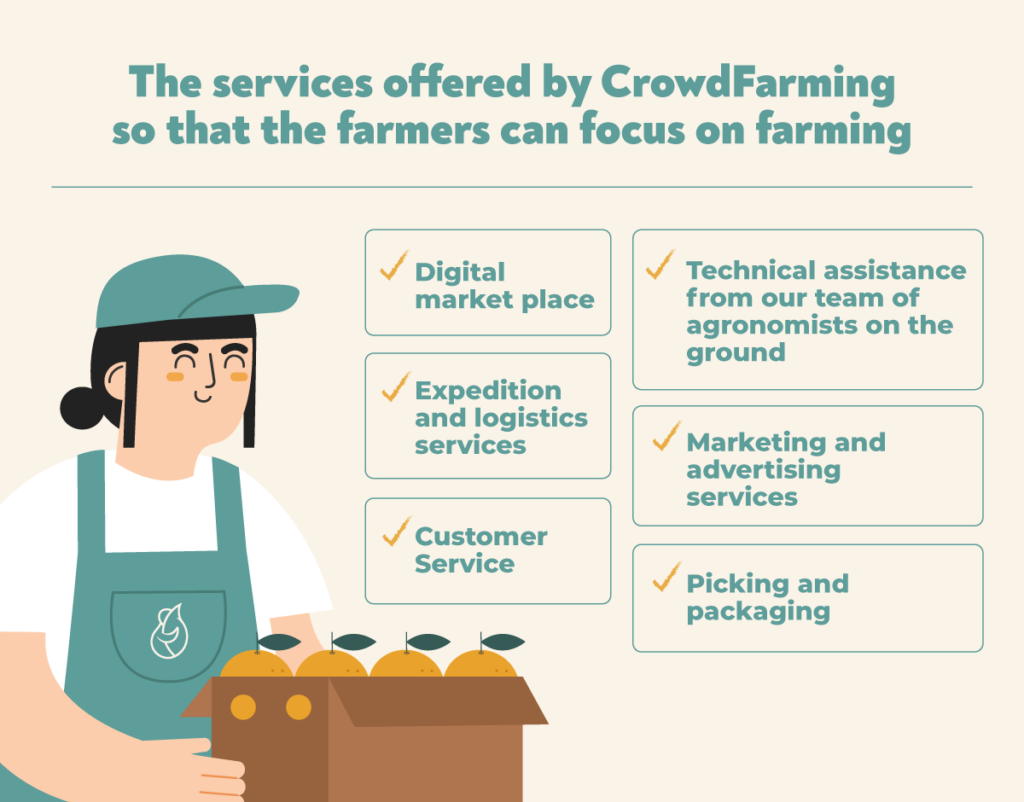
CrowdFarming’s mission is to offer all the necessary services to allow farmers to focus solely on farming. These days, if a farmer wants to sell directly to the consumers they have to not only do farming work, but also need to do marketing, administration, logistics and packaging, finance, customer service, and more. So we take care of these sides of the business, so the farmer can focus on growing and harvesting their products.
Services CrowdFarming offers to let the farmers be farmers
- Digital marketplace
- Expedition and logistics services
- Customer Service
- Marketing and advertising services
- Picking and packaging, or preparing the boxes, can either be done by the farmer, or by one of our “CrowdLog” logistic centres.
Transport costs and incentivising efficiency
As consumers, it can be easy to underestimate the implications of shipping CrowdFarming boxes. Our products are fragile and sensitive, and it’s really important to us that the journey to be as quick and as efficient as possible. This, of course, has a price that depends on the number of km travelled and volume.
Given the context in the last year, transport costs have become more significant. Currently, we are paying around 25-30% of the final price to the transport companies.
The more efficient we are (by calculating precisely the quantities and sales, by studying the best routes to take, by making sure that trucks travel at full loading capacity etc.) the better it is for the planet, and it helps us reduce costs on this percentage. If we are able to reduce the final cost, we can choose to lower the final price to increase sales or to improve our margins to invest in offering more services to the farmers.
Secure payments have a price
Regarding the payment services, we usually pay around 2% of the final price to the payment provider. (PayPal, visa, Klarna etc.) In total, the financial cost can be of around 4% if we incorporate frauds and payment rejections.
Picking and packing
This part of the price can go to the farmer or CrowdFarming, depending on who is taking care of this part of the process. We came to realise that this is a lot of work for the farmer — who often doesn’t have any logistic resources on the farm for direct sales operations — so we also offer these services through our own logistic hubs (like the one in Valencia that you can learn more about in this article). A beautiful thing CrowdFarming has made happen is to help farmers that excel at picking and packing to provide this service to other farmers in the area.
Simply put, if the farmer does the picking and packaging, he gets the cut, if CrowdFarming does the picking and packaging we get the cut.
Avocado pricing in detail
Although these percentages may seem like simple calculations, there are a lot of different variables that will affect the price of a CrowdFarming order, whether it is an adoption or single boxes, the size and format of the box (subscription, mixed box etc.), the destination country (this affects transport costs and tax).
Again, and to make it very clear, what does not change, under any circumstance, across the whole season, is the price per kilo the farmer gets and which was set by him at the beginning of the season.
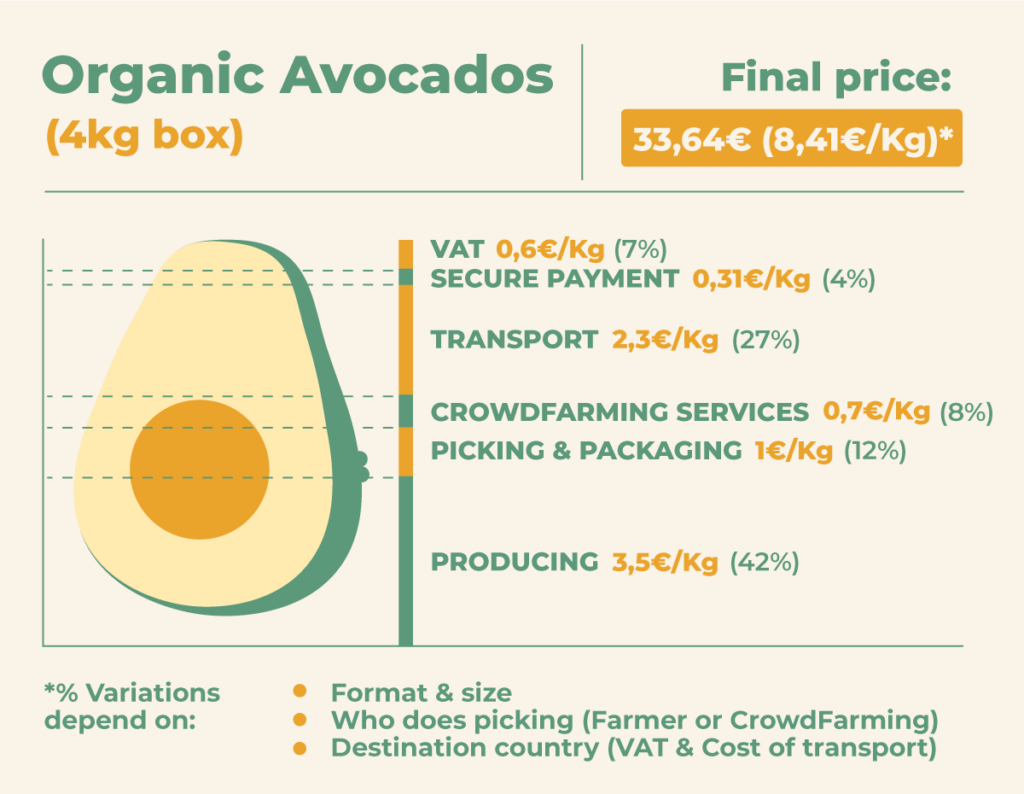
To try and make this more tangible, let’s look at a concrete example of a specific box and journey. In this case, we have selected a box of 4 kg of organic avocados going from Spain to Germany.
The final price for this box would be 8.4 euros per kilo (which adds up to 33.64 euros total for the box).
- Price set by the farmer: 3.5 €/kg (42% of final consumer price)
- Picking and packaging: 1€/kg (12% of final consumer price)
How this is calculated [4€ approx per box prepared]
- CrowdFarming services: 0,7€/kg (8% of final consumer price)
How this is calculated [22% of farmer price 3.5 equals 0,7€]
- Transport services: 2,3€/kg (27% of final consumer price)
How this is calculated [27% of final price 8.4 equals 2.3€]
- Secure payment services: 0,3€/kg (4% of final consumer price)
[1,5€ approx per transaction]
- VAT taxes: 0,6€/kg (7% of final consumer price)
It’s not always easy for us as consumers to understand where our money goes, but it is crucial. Consumers are a key part of the transition to a fairer and more sustainable food supply chain, and to reach our goal of creating this transition, we encourage consumers (or potential consumers!) to be conscious of the source of their food and where they buy from, but for this, the information has to be made available!
We hope this article helps give some clarity on where the money goes for each CrowdFarming box, and if you have any questions or doubts, drop them in the comments or contact our customer service team who will be happy to help!
Farmer at CrowdFarming
Written by Gonzalo Úrculo

Gonzalo es un "farmeneur". Como cofundador de CrowdFarming y agricultor, divide su tiempo entre la oficina y el campo. Además de la agricultura, disfruta leyendo y escribiendo sobre productos digitales y logística y discutiendo sobre su impacto en la cadena de suministro de alimentos.
Keep digging ...