




Published March 2026
Heated greenhouse tomatoes, imported tomatoes
We have become accustomed to having almost all fresh produce grown globally available at any time of the year. This sea of possibilities is mainly achieved in two ways – by importing from other countries or by creating artificial environments for the plant to grow locally – in other words, greenhouses.
However, as awareness of environmental impact increases, we ask ourselves according to what factors we make our consumption decisions – distance to the place of production, water consumption, energy consumption? Specifically, in this article we explore the factors that may influence the decision to import a product or to grow it locally in artificially heated greenhouses.
Studies have found that the environmental impact of the agri-food industry is closely related to the artificial control of temperature – either heating or cooling – for food production and preservation:
- 85% of the impact in cold climates is due to heating and electricity processes.
- 65% of the impact in hot climates is due to refrigeration and electricity processes.
It is important to consider both carbon footprint and water availability when selecting the best option. Some studies have concluded that, from a carbon footprint perspective, importing vegetables produced in warm southern countries during periods when northern production requires heating may be more beneficial.
From a water perspective, sourcing vegetables from water-scarce countries raises questions – although we have to bear in mind that the impacts of water scarcity also vary according to the specific location within the country and the more or less efficient water management on each farm or greenhouse.
But let’s take a closer look at the alternatives:
Importing vegetables actually offers certain advantages compared to the use of heated greenhouses.
Firstly, from an environmental perspective, importing tends to generate less greenhouse gas (GHG) emissions in general, including those related to the transport of the products. By not requiring the use of greenhouses, the emission of gases associated with the heating of these enclosed spaces is avoided. This reduction in GHG emissions contributes to climate change mitigation.
However, it is true that importing vegetables also has its weaknesses. In terms of water resources, as mentioned above, vegetable-producing countries, which are warmer and suitable for year-round cultivation, tend to require more water. Especially in water-scarce regions, such as arid or semi-arid areas, vegetable production can put additional pressure on local water resources.
Furthermore, at the land use level, outdoor production needs more land to obtain the same amount of production compared to greenhouses. This is because greenhouses allow for better control of the environment and thus greater efficiency in land use.
In summary, importing products from warmer countries:
- Has advantages in reducing GHG emissions and plastic footprint.
- May be less efficient in the use of water and land resources.
There are many different types of greenhouses, but there is one major difference that separates them.
On one hand, there are artificially heated greenhouses, and on the other hand, there are greenhouses that produce a greenhouse effect – a rise in temperature – solely by means of solar energy. The latter do not require additional energy for temperature control and are the most common in already warm areas such as southern Europe.
The former, artificially heated greenhouses, are a production tool that offers significant advantages. Firstly, they allow food production outside the typical growing season, which eliminates dependence on the time of year for fresh produce. This challenges the traditional concept of “seasonality” and gives us access to a variety of foods all year round.
In addition, heated greenhouses give us the ability to grow anywhere in the world, regardless of local climatic conditions, including the availability of sunshine hours, temperature and humidity. This is especially relevant in regions where outdoor farming would be limited or even impossible.
It should be noted that many of the advantages that greenhouses can bring to cultivation are not necessarily related to the use of heating. For example, in warm regions, such as the south of Italy or Spain, greenhouses and shade nets are also used to cool down temperatures during summer months by reflecting sunlight. In other latitudes, -like Germany, France or the North of Italy- they are used to prevent storm damage, such as hail, which has become increasingly common. This provides farmers with more certainty of a successful harvest.
The level of control of the environment depends mainly on the innovation, investment and energy devoted to adapting these environmental factors so that the plant can develop in an optimal way, through the control of temperature, light, humidity, water cycles, etc. In short, a process that can be highly costly in financial and energy terms and that we see exemplified in cannabis production.
However, it is important to recognise that this apparent advantage comes at a significant environmental cost. To achieve the efficient operation of heated greenhouses, a major investment of resources, both material and energy, is required. Constant heating to maintain an optimal temperature inside the greenhouse consumes a considerable amount of energy, which can have a negative impact on greenhouse gas emissions and contribute to climate change. In addition, the use of materials in greenhouse construction, such as plastic, can also generate waste and have an impact on environmental pollution.
In summary, greenhouse growing:
- Offers advantages in off-season production and adaptation to different climates.
- Has a high environmental cost associated with greenhouse gas emissions and the use of plastic resources.
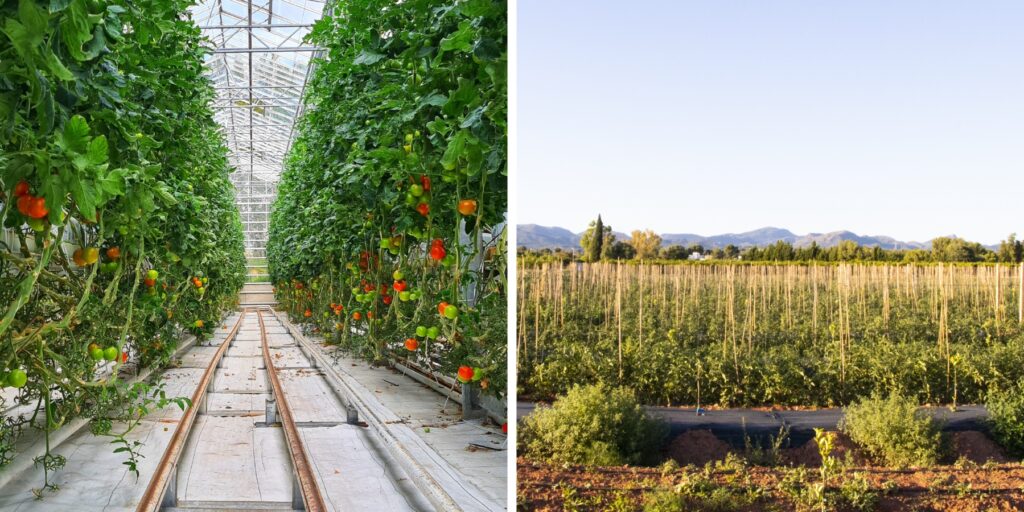
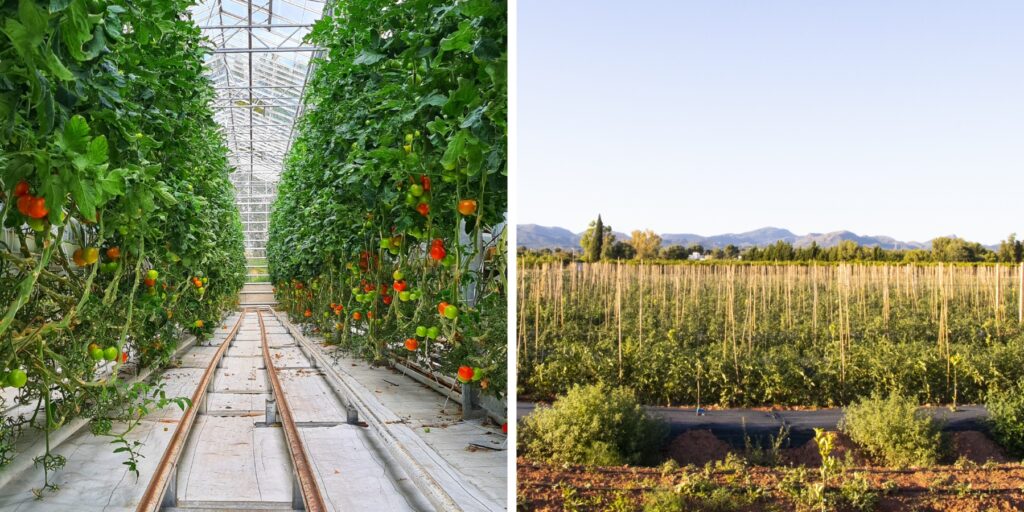
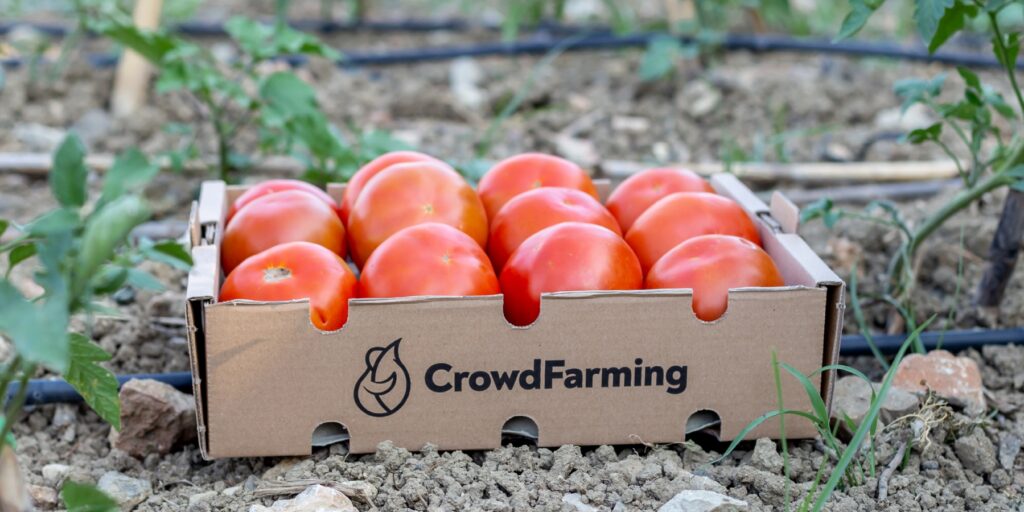
Let’s take a look at the case of tomatoes.
Tomatoes are mainly imported from warmer countries such as Spain or Morocco to countries such as Germany or France. A study conducted by the French Agency for Environment and Energy Management (ADEME) and the Centre for International Cooperation in Agronomic Research for Development (CIRAD) examined the import of tomatoes from Morocco to France, which covers 68% of imported fresh tomatoes.
According to this study, the cultivation of tomatoes in unheated greenhouses in southern Morocco and their subsequent export had a lower impact on energy use and global warming compared to French tomatoes grown in heated greenhouses. It was also confirmed that exported tomatoes from Moroccan unheated greenhouses had a significantly lower impact than local French production in heated greenhouses in terms of marine and freshwater eutrophication, with a 95% and 38% reduction, respectively. Even considering packaging and transport, the impacts are reduced by 79% and 8%, respectively.
On the other hand, we should not forget that water-intensive crops in water-scarce areas pose significant problems. The freshwater demand of Moroccan tomatoes was almost four times higher (28.0 L H₂Oeq per kg compared to 7.5 L H₂Oeq per kg for French tomatoes). This does not detract from the fact that water efficiency measures can play a key role in reducing the water footprint of the product.
It is important to mention that the study is not reflecting other more complex issues, such as production conditions at the place of origin.
Not all tomatoes are the same.
Growing tomatoes under natural conditions, in a substrate – in the ground – and outdoors, with direct exposure to the sun, can significantly benefit their growth. There are several reasons why this practice can be advantageous.
Firstly, the use of a natural, nutrient-rich substrate provides a wider variety of essential elements than those found in greenhouse conditions. This favours the development of healthier, more nutritious and higher quality fruit.
In addition, since tomatoes are fast-growing, they need at least 6 to 8 hours of direct sunlight daily. Direct sun exposure greatly influences the organoleptic qualities, including of course smell and taste.
How do the sun and the plant relate to each other? Sunlight has different wavelengths at different times of the day, such as dawn, midday and dusk. Each wavelength of light has a specific colour that plant leaves perceive. These colours provide different benefits to tomato plants. For example, red light helps the plants to develop their fruits while growing tall and strong, while blue light contributes to the production of firmer fruits and their ripening at the most appropriate time. On the other hand, violet light will help prevent disease or fungal growth on plants. In order to receive this full range of colours, it is always preferable that the plants are not exposed to structures that provide them with partial or total shade.
Finally, we have to take into account that the tomato is a climacteric fruit. This means that its ripening process continues and is completed once it has been detached from the rest of the plant, a process that can last several days. For this reason, if the tomatoes are harvested in a suitable state and transported quickly in optimal conditions of temperature and humidity, it is possible not only to maintain their qualities – such as flavour, texture and colour – during the journey from the field to the CrowdFarmers’ homes, but also to ensure that they arrive at an optimal time.
What is the best solution?
In summary, both heated greenhouses and vegetable imports present advantages and challenges in terms of food production.
Although heated greenhouses allow off-season production in different climates, they come at a huge environmental cost due to the higher consumption of energy resources. On the other hand, importing vegetables reduces greenhouse gas emissions and the plastic footprint, but may require more space and water resources if not managed efficiently.
On the other hand, we have to take into account how the environment in which a tomato grows, the sun it receives and the soil in which it grows affect its nutritional and organoleptic quality – the taste – especially if it is organic soil, or even more regenerative soil, with more life inside and a greater capacity to transmit nutrients and minerals to the plant and, consequently, to the product.
And who doesn’t long for a good old-fashioned tomato?
Sources:
- Payen, S., Basset-Mens, C., & Perret, S. (2015). LCA of local and imported tomato: An energy and water trade-off. Journal of Cleaner Production, 87, 139–148. https://doi.org/10.1016/j.jclepro.2014.10.007
- Stoessel, F., Juraske, R., Pfister, S., & Hellweg, S. (2012). Life Cycle Inventory and Carbon and Water FoodPrint of Fruits and Vegetables: Application to a Swiss Retailer. Environmental Science & Technology, 46(6), 3253–3262. doi:10.1021/es2030577
- Pyrgioti, S. (2022, December 22). The great debunking of climate myths: Transportation. CarbonCloud. https://carboncloud.com/2022/03/28/climate-myths-transportation%EF%BF%BC/
- Golzar, F., Heeren, N., Hellweg, S., & Roshandel, R. (2019). A comparative study on the environmental impact of greenhouses: A probabilistic approach. Science of The Total Environment. doi:10.1016/j.scitotenv.2019.04.092
Written by Fran Aparicio

Fran Aparicio coordinates Regenerative Agriculture at CrowdFarming, which mostly means he spends his days trying to make farmers, scientists and data people agree on what “healthy soil” actually means. He lives somewhere between muddy boots and research papers, translating field reality into something you can measure (and hopefully improve).
Keep digging ...