


Published March 2026
The Canary Island Banana
Unless you are Spanish, or have spent the summer in the Canary Islands, it is difficult to get to know our beloved Canary Island banana. Aside from the world’s major banana producers (India, Ecuador, Brazil and China), there are small pockets of the European Union where we can also find this fruit. The bananas produced in the Canary Islands have their own style, they are dressed in yellow with black spots, and a key benefit is that they are only four days away from arriving on the coasts of Spain.
This archipelago is one of the closest points to continental Europe where the climatic conditions ideal for banana cultivation can be found. This has a direct impact in two ways:
- The reduction of emissions in its commercialisation. The bananas from the Canary Islands travel 4 days to the mainland of Spain, while the bananas from Latin America usually travel 18 days before reaching Europe.
- Farmers do not have to harvest the fruit prematurely. They can leave it on the plant longer until it reaches optimum ripeness, and this has a direct impact on its flavour and aroma.
Furthermore, we must keep in mind that the legal requirements for the production of Canary Island bananas are those demanded by European regulations.
When we talk about quality at CrowdFarming, we do not limit ourselves to referring only to taste. Our concept of quality obviously includes the search for the best products from the organoleptic point of view, but it is also essential that it is grown in a way which respects the environment, and is fair in terms of the people involved in its production. The Canary Islands is the ideal place for us to find farmers.
Farmers’ Associations
The Canary Islands is the region with the most smallholdings in Spain. Smallholdings are considered to be small farms which, due to their size, have difficulty in achieving efficiency. There are currently 11,385 farms in the Canary Islands, with an average size of 4.81 hectares. A smallholding is, by definition, so small that it prevents the farmer from obtaining sufficient production to be marketed or to obtain sufficient monetary income.
Because of this, Farmers’ Associations or cooperatives have been created in the Canary Islands in order to be able to gather sufficient production to be marketed. These groups of farmers are responsible for harvesting the bananas, packing them, and transporting them to the mainland in order to market them.
Naturally ripening climacteric fruit
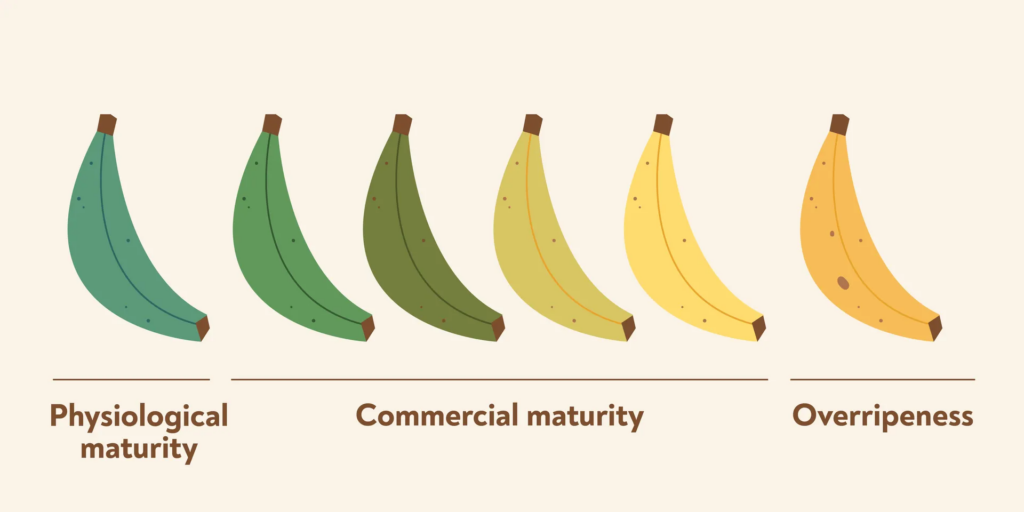
The banana from the Canary Islands has to travel about four days to reach one of the ports on the Peninsula. It is harvested when it has reached its physiological maturity, that is to say, when it has fully developed on the plant and reached its maximum size. A physiologically ripe banana is green, very green in fact, and it doesn’t yet have a good taste nor aroma. Fortunately though, this fruit is climacteric, and continues to ripen after being harvested.
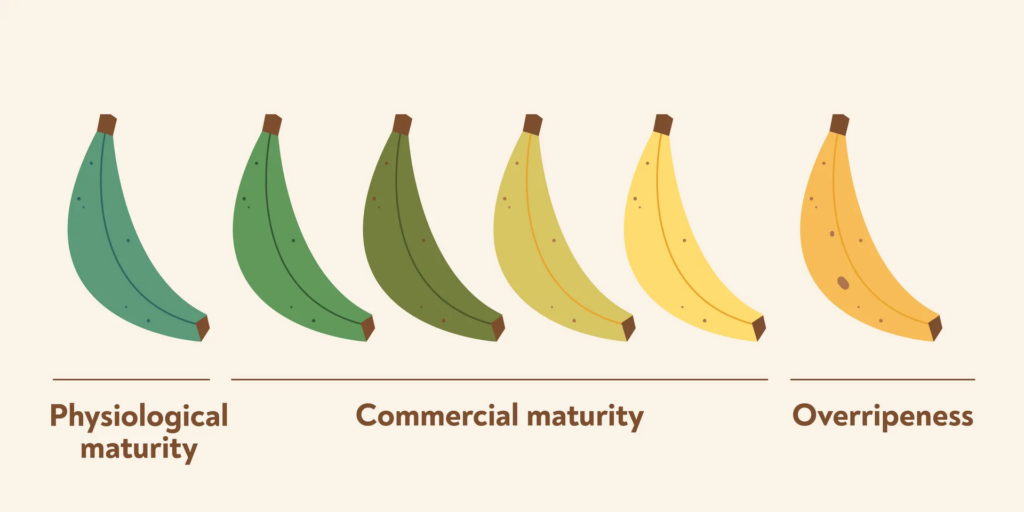
There are two factors that influence the ripening of bananas; temperature and ethylene concentration. In this article we explain two methods that can be used to ripen bananas:
- Industrial ripening: in order to artificially ripen bananas, the industry uses artificial ripening chambers before sending them to supermarkets.
- Home ripening: commonly used by banana farmers themselves for self-consumption.
The conventional market uses forced ripening by keeping the not-yet-ripe bananas in ripening chambers with high ethylene concentrations, temperatures around 16ºC, and high humidity to avoid moisture loss in the skin. This way they obtain a fruit with a bright, colourful and visually attractive to the consumer. We all know that unfortunately, attractive fruit is the first to get snatched up in the supermarkets, and if the bananas were to appear still green or not very shiny, then sales would suffer.
The Farmers of CrowdFarming wanted to opt for the direct sale of bananas, meaning that they travel from the banana plantations to the households, without going through artificial ripening chambers. This way the consumers receive green bananas with sufficient physiological ripeness, that they can keep for longer at home while they ripen.
How to ripen bananas at home?
To get bananas – and any other climacteric fruit – to ripen, you only need two things, ethylene and a reasonable temperature:
- Temperature
When we keep any food in the fridge, it preserves the state of the food and allows it to last longer thanks to the low temperatures. At higher temperatures, fruits and vegetables ripen faster. As bananas do still have to ripen to reach the best point for consumption, a temperature above 16ºC is ideal to complete the ripening process.
- Ethylene concentration
Climacteric fruits naturally emit ethylene, a gaseous hormone that causes the natural ripening of these types of fruits. Below is some key information that helps explain the role of ethylene in the natural ripening of climacteric fruits, and bananas in particular:
- The higher the temperature, the higher the ethylene emission (that’s why we need a temperature higher than +16ºC).
- The presence of ethylene causes more ethylene to be emitted, i.e. if you put a ripe fruit next to a less ripe fruit, the latter will start to emit more ethylene and in turn will ripen more quickly.
- Ethylene breaks down chlorophyll (the pigment responsible for the green colour of the fruit) causing the banana to change from green to yellow.
- Ethylene causes the texture of bananas to change as they ripen too, making them softer and more pleasant to eat.
- The Canary Island banana is well known for its intense aroma when ripening, a consequence of its richness in isoamyl acetate and hexyl butanoate, known as the “banana impact”.
Note: to get the ethylene concentrated and your bananas to ripen, place them in an airtight container with some ripe fruit.
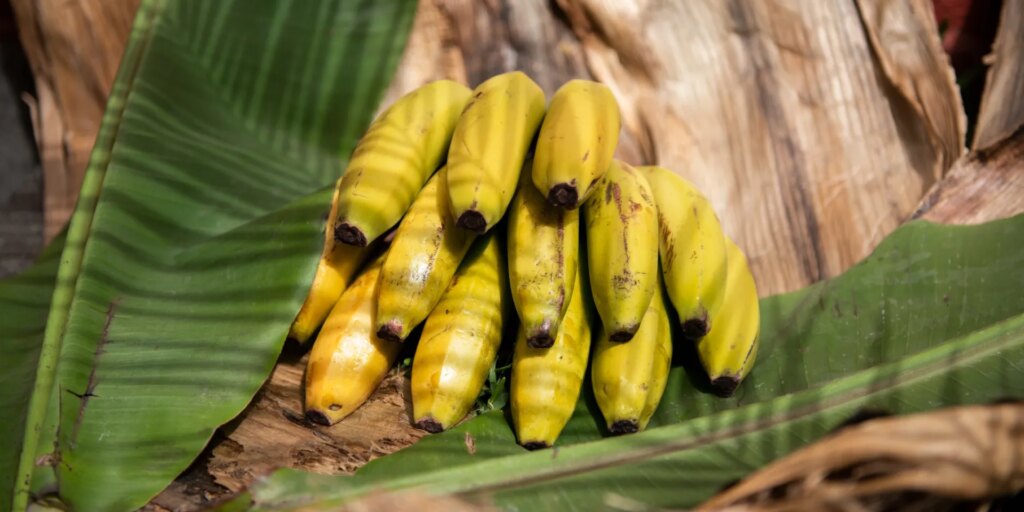
Perhaps the most distinctive characteristic of the Canary Island banana is the black spots on the skin. These specks or marks appear especially where the banana has been affected by friction (from wind, volcanic ash, transport, etc.) and are an identifying feature. Their appearance is another sign of when the banana is at its optimum point of ripeness for consumption.
One of the advantages that we want you to experience by ripening the bananas naturally is to achieve a staggered ripening process, allowing you to consume the bananas gradually. We recommend that you ripen only the bananas that you want to consume in the short term, starting with the bunch that has the fewest greenish bananas. After a few days you can repeat the process with more of the bananas.
Ripening bananas at home is maybe less convenient than buying them already ripe, but by doing it this way we manage to avoid all the energy costs of artificial ripening, and we receive fresher fruit!
Written by Javier Tornos

Keep digging ...