
Nurturing nutrition, a conversation with Dan Kitteredge
#4 | July 2026
Published October 2026
Nurturing nutrition, a conversation with Dan Kitteredge
Listen on your favourite audio platform.
Bionutrient Food Association founder Dan Kittredge on why organic certification is not a nutritional guarantee, what your tongue already knows, and the race to put a nutrient scanner in every smartphone.
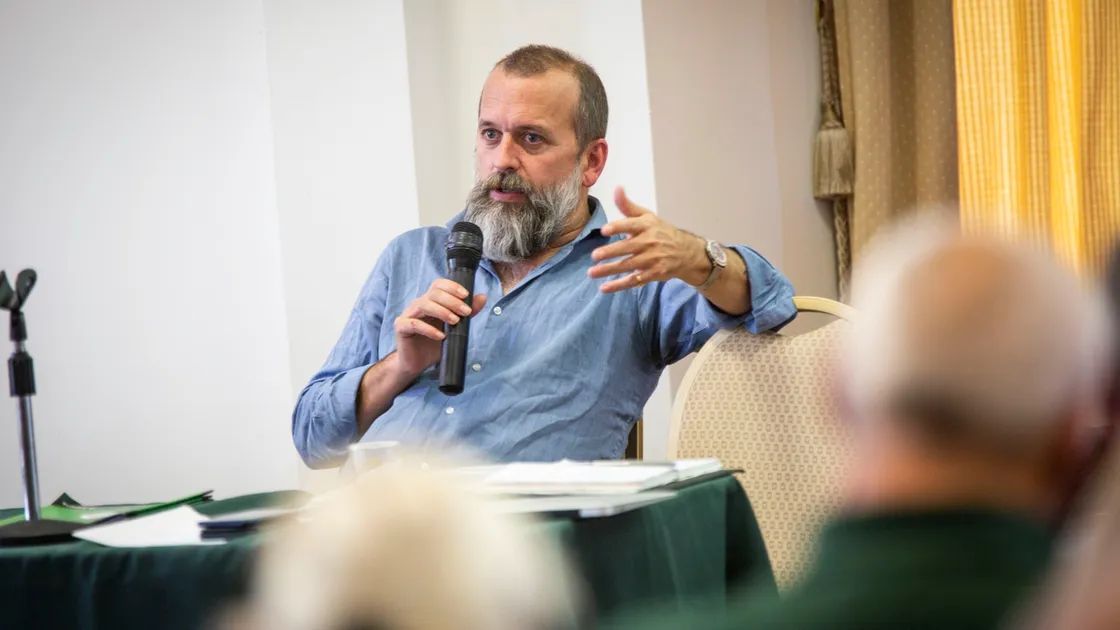
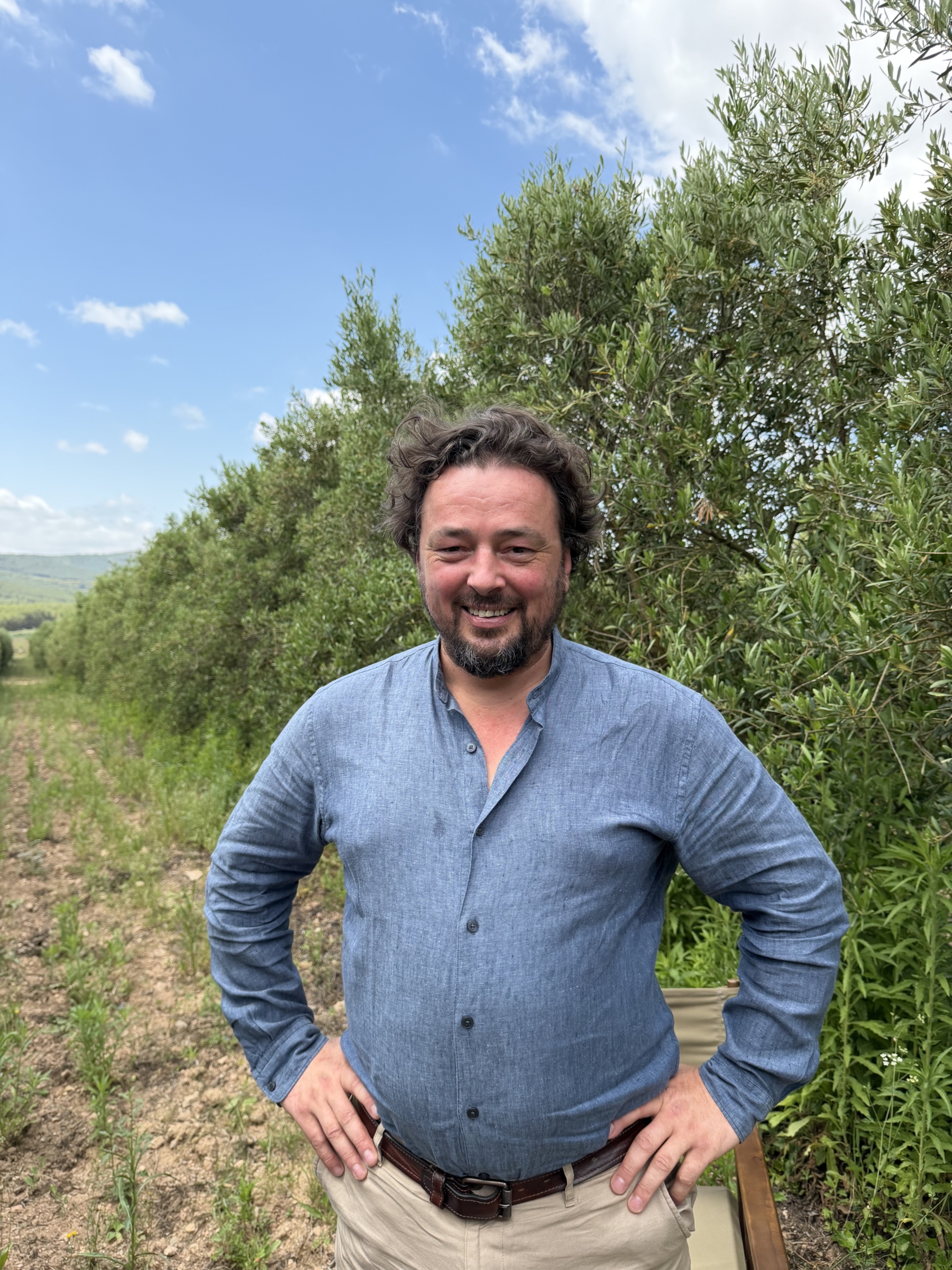
Dan Kittredge grew up on an organic farm in the United States, the son of two founders of the American organic movement. He went on to become a farmer himself, then an NGO director, and eventually the person who coined the term “nutrient density” as we now use it in food systems conversations. For nearly twenty years, through the Bionutrient Food Association, he has been building the science to prove what many farmers and eaters sense intuitively: that not all food is equal, that the difference is measurable, and that the market has so far been rewarding the wrong things. We spoke about the gap between certification and nutrition, the physics of tasting well, and why he thinks a phone camera could change everything by 2030.
The first thing Dan Kittredge wants to dismantle is the assumption that organic means nutritious. It is, he acknowledges with some affection, the assumption he grew up with. His parents spent 35 years leading an organic farming organisation in the United States and helped write some of the country’s first organic standards in the 1980s. He sold potatoes and blueberries at the farmers market every Saturday morning as a child, nose in the air, certain they were better. “I’m standing on their shoulders,” he says, and he means it. But the science, when he eventually looked at it, told a more complicated story.
You come from an organic farming background and you’ve spent nearly twenty years questioning whether organic automatically means more nutritious. What did you find?
The first mistake is to think that organic is uniform. Food is not uniform. Anyone who has eaten a tomato off the shelf in January and a tomato off the vine in August knows the scale of that variation in their own mouth. Your tongue is a very sophisticated nutrient monitoring system. When something tastes better, not sweeter but more flavourful, it is more nutritious. And there is a massive variation in nutrient levels across organic produce, across regenerative, across permaculture, across local, across conventional. None of those categories is uniform. You cannot say that any of them is reliably better.
How did you come to understand that? Was there a moment when the question of nutrition became more urgent for you than the question of certification?
I was a farmer who couldn’t make a living. I had a young family, I was struggling with pest pressure, disease pressure, failure to thrive, and I was trying to figure out how to pay the bills. The questions I was asking were practical ones: how do I cause plants to not be pest and disease susceptible? And what I found is that the answer runs through the functionality of the soil life. Soil health is plant health is pest and disease resistance is farm viability is flavour is nutrition is human health. That is one interrelationship. And a lot of the practices I was brought up with in organic do not facilitate soil health. Just because you are not using chemicals does not mean you have optimised soil health. Just because you are cover cropping and no-tilling does not mean you are optimising soil health.
Can you give an example of how good intentions and good practices can still miss the point?
If the thing that is impeding soil health is aeration, if the microbes in the soil need air to breathe and your soil is tight and compacted, those microbes are asphyxiating. It does not matter if you have cover crops, it does not matter if you have not applied chemicals. The microbes cannot breathe and they are dead. Until you understand that microbes need air like chickens do, and you solve that specific problem, you will not have soil health. There are 85 different ways of solving that problem. But you have to understand the root cause and work systemically to address it.
A lot of what is happening in regenerative is a process-based standard. If you do these things, you claim regenerative. It is a bit like religion. If you do five Hail Marys, does that mean you are closer to God, or you have just done five Hail Marys? You have planted cover crops. That does not necessarily mean you have better soil health. Each piece of land is unique, it is alive, and only when you as a farmer are humbly listening and serving that land right here, right now, should you expect its vitality to increase.
You ran a major research programme sampling 10,000 crops across two continents. What did it find?
We sampled 25 different crops across hundreds of farms, and we overlaid soil metrics and management practices trying to tease out what actually causes nutrient variation. What role does genetics play? What role does soil type play? Fertility programmes, management practices, certifications, points of purchase? None of them seemed to correlate. You can take a bag of carrot seeds, plant them in ten different soils, and have massive variations in nutrient levels. You can take one field, manage it differently in different seasons, and have massively different nutrient levels. Organic versus not organic does not correlate. Local versus not local does not correlate. Soil type is not a causal factor. Genetics is not a causal factor.
The thing that connected to nutrient variation was levels of life in the soil. The function of the microbiome. The more well the land is functioning, the healthier the plant is, and the more nutritious the food that comes off it.
So it is not a snapshot of soil health at any given moment, it is about the whole life of the plant.
Exactly. You can take a soil test in April and that will tell you at one moment which nutrients are there and which microbes are there. But the plant grew from when it was planted to when it was harvested, and during that entire time it was experiencing life. Think of raising a child. If the first three years of that child’s life it eats macaroni and cheese, that is a formative time. Its bones are not going to be as dense as they could be. Its immune system is not going to be functioning well. For the rest of that child’s life it will not be as healthy as it could be, because what it experienced early on has a ripple impact. The functionality of life in the soil through the entire life of the plant is what seems to correlate to nutritional outcome.
What has caused the general decline in average nutritional quality over the last 75 years?
The market has been paying farmers based on volume and aesthetic. If you are a farmer and you want to make a living, you do not get paid on nutritional calibre. You get paid on kilos, on bushels, on tons, and on aesthetic uniformity. The market has been incentivising a set of practices that are in most cases antithetical to nutritional calibre. That is why the averages have gone down.
Though I want to push back on the idea that everything in 1950 was good and everything now is bad. There was always a full spectrum of variation at any point in time. What has changed is that the incentive structure has been driving the averages in the wrong direction.
And the data backs that up, even for farms that believe they are doing everything right.
The graphs are embarrassing, honestly. Almost all food is way worse than it could be. The bar is embarrassingly low for everything. The opportunities to improve are everywhere and it is not hard to do way better. It is just a question of who wants to take the first step and how we can work together. And let us start with humility. Do not start being cocky and arrogant: “I am organic, I am better. I am regenerative, I am better.” Let us build an open data base. Let us have a scientific framework where we all agree this is a scientific process, we are getting our dogmas out of the way, and we are just measuring.
Your research has also taken you in a more unexpected direction, making the case that the human palate is actually a reliable instrument. How does that work?
Around 30% of our DNA is associated with the function of our nose and our tongue. That is not an accident. The compounds we call flavour and aroma, polyphenols and terpenoids, only get built in the plant in high levels when everything else is present. When the full biochemical complexity, all the vitamins, all the enzymes, everything else is present, only then can the plant build these flavour compounds. So being able to taste and smell well is essentially evolution’s way of telling you: if you eat this, you will be more well, and your children will be healthier.
And if you follow that track forward, that is where we are now. Three or four generations post the Green Revolution, we have been building our bodies out of insufficient substance. We have children, and their bodies are built even less well, and then less well again. We have epidemic levels of chronic disease because we are physiologically degenerating. Our nutritional status is getting weaker and weaker. It takes time for life to wear out. But you can build it back up. If you start eating well, it reverses. Your body is essentially renewed every six months.
You have also been developing instruments to measure nutrient density more precisely. Can you walk us through what you have built?
One is a handheld spectrometer we built in 2017 and calibrated with those 10,000 samples. It is very rudimentary, 3D-printed case, screws, built-in-a-garage kind of thing. But we were able to get a paper published in Nature Scientific Communications showing that when it flashes light at a carrot, it can read the level of antioxidants in that carrot, and send the reading via Bluetooth to your smartphone. You can flash the light at a courgette and get a reading on polyphenols. Flash it at wheat berries and get the protein level. That is where we are going: when the research is complete, it will be the camera in your phone.
You pull your phone out of your pocket, you flash a light at three different brands of carrots on the shelf, you see the readings, and you choose. You are reading the carrot, not the QR code, not the label. And if you get a better reading from one source consistently, you tell your friends. Everybody in town will know pretty quickly which products are performing and which are not.
The other instrument you have with you is a refractometer. That is a much older technology.
195 years old, no battery. You take a piece of the tomato, put it in a garlic press, squeeze out a drop of juice, place it on the refractometer, look through the eyepiece, and you get a number on a scale. That number is Brix. It measures total dissolved solids, the degree to which light bends when it passes through the juice. The more watery a food is, the less the light bends. The more full of substance the food is, the more the light bends. It is not a direct measure of nutrient density, but it correlates with flavour, with shelf life, with pest and disease resistance, with vigour. As a stand-in, it is the best thing we have right now.
Brix was actually named after the Austrian chemist who solved a problem the German vintners posted as a prize challenge in the 1830s: why do some grapes make great wine and others make vinegar? Brix figured it out and the measurement was named after him, just as Celsius, Fahrenheit, Richter, Ohm and Volt had scales or units named after them.
You are launching a citizen science app around the refractometer. How does that work?
Anyone who wants to can take a refractometer and a garlic press. When you bring home your shopping, you take a reading, and you upload the date of purchase, point of purchase, brand and reading onto the app. We the people, citizen science, bottom-up, before all the peer-reviewed science is complete, can begin to assess the supply chain and see where better and worse are. It is an iterative process. You do not need to wait for everything to be figured out at the top to start building the picture from below.
The spectrometer research is more expensive. Who funds that kind of work, and who should?
The reason this research has not been done is that no one with deep pockets has found it to be in their economic advantage. The player with the best interest is us, the people. If it costs around 800,000 euros per crop to build the nutritional standard, and you have 100,000 people who care, that is eight euros per person. Eight euros for blueberries this month, eight euros for apples next month.
What we have noticed is that what drives people above everything else is the health of their children. If you are a parent, the health of your children takes precedence over pretty much everything. And what will drive real change is a guarantee that the product you are buying is actually healthier for your family, backed by science you can hold in your hand.
You also believe big food companies are beginning to pay attention.
I am in boardrooms and corporate headquarters of some of the biggest food companies on the planet. What many of them have come to understand is that this whole movement is coming, and they do not want to be embarrassed when people can measure. Whichever large food company decides first to move to improve the nutritional calibre of its supply chain, when we are able to measure, they are going to gain market share. They will have better supply chain resilience, better ecosystem impact, better flavour, a much better marketing strategy. Those who want to move and evolve will be more profitable. Those who want to be recalcitrant will lose market share.
By what timeline do you think this could be available as a consumer tool?
By 2030 it is entirely plausible for dozens of crops, if the research funding comes through. We can do the research per crop in around six months, and we can run twenty crops at once, if we have the resources. The momentum is building. It feels imminent.
What would you say to consumers right now, before any of that technology exists, who want to make better choices?
Hone your sense of taste and smell and use that discernment. If a tomato is particularly flavourful, it is almost certainly more nutritious. That is not a vague claim. It is the biology. And if you have access to a refractometer, use it. Take readings when you get home from the shops, upload them, contribute to the picture. The science does not have to be complete for you to start participating in it.
What has your family made of the direction your work has taken, given that they helped build the organic movement you are now complicating?
I think they are maybe secretly a little bit proud. Secretly, though. But I think they should be proud of what they did. They helped make organic a thing when it was not a thing. I am only able to do this work because of the background and perspective they gave me. And the base they built matters. No chemicals is a huge step forward from chemicals. On principle, the application of toxic chemicals is counterproductive to overall system function. It is just not sufficient on its own.
What I try to say is: those who live in glass houses should not throw stones. Until you have an optimally functioning biological system, do not bother judging others. Be humble and ask how you can do better. It is much easier to judge others. But it is not helpful. And right now, we need all of us at the table.
Written by Emilia Aguirre
Emilia Aguirre is our Awareness & Advocacy specialist — which means she spends her days asking the uncomfortable questions about how our food is grown, priced, labeled, and sold. She hosts What The Field?!, a podcast packed with stories from the ground, hard-hitting research, and conversations with the people shaping the future of food (whether they like it or not).
Comments
Keep digging ...