

Published October 2026
A Recap of our Regenerative Farming Workshops with Climate Farmers
It is key to highlight that these workshops are not the end goal. On the contrary, they intend to be a space for farmers to learn more about the science behind regenerative practices, to share amongst each other their challenges and how regenerating can contribute to their farm’s business and ecosystem. These two farmer meetings were meant to plant the seed of changing the way we approach agriculture from a plant-product vision to a much more holistic approach with soil as the main character.
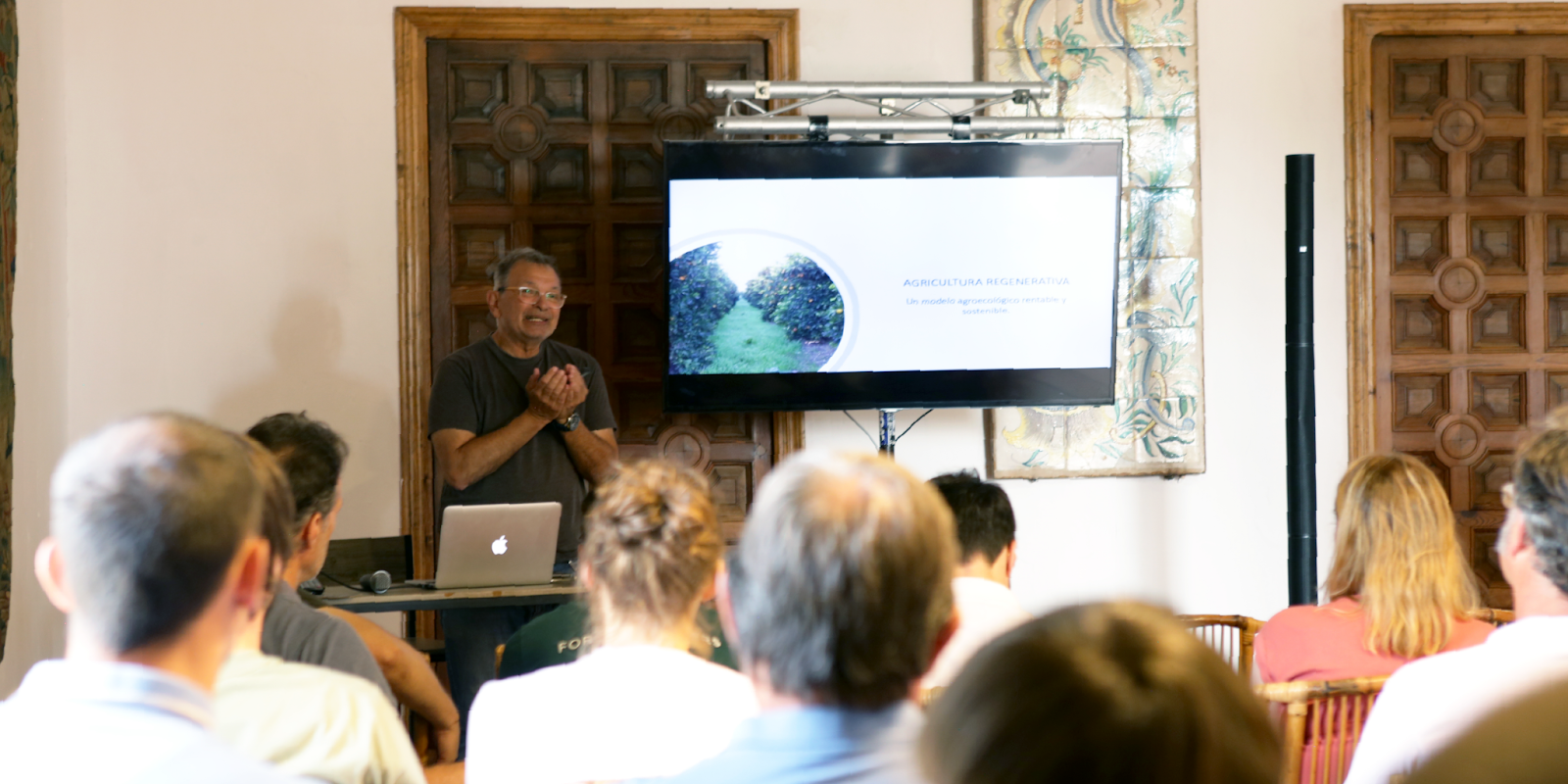
Valencia area: Back to the roots in Naranjas del Carmen, the founders’ orange farm.
Our first workshop was set on our founders’ family farm “Naranjas del Carmen”. An ideal space for this first event, seeing as it is a farm already shifting to regenerative practices.
For each workshop, we invited experts in the field to share their knowledge and experience. Our first guest speaker in Valencia was Alberto Peréz Roldán, a scientist and advisor to producers, as well as a soil specialist. He started by highlighting the importance of having a holistic vision of agriculture and understanding that healthy soil is the key to producing healthy crops and healthy food.

We learned how to read what was happening in the soil through the signs plants show us, and we had a hands-on experience of running a soil analysis with our second guest speaker, Manuel Lopez Jerez. We understood that our farms should mimic nature’s diversity to favour healthy crops, which means we need to abandon the misconception that we can sustain our agri-food system on just a few elements such as nitrogen, phosphorus, or potassium.

Andalusia: The land of the subtropical fruit within Europe’s borders.
Our second workshop in Malaga welcomed mainly citrus, olive and subtropical fruit farmers (mango, papaya, avocado, etc.). Some of these farmers have been facing the tough climate conditions we have witnessed lately, while their products have faced stigmatization, even when farmed responsibly.
Our guest speakers for this event, Miguel Ángel Gómez Tenorio and Francisco Rodríguez León shared successful case studies of farms in water-pressured areas, either for rain-fed or irrigated crops. They have been working with farmers for years to learn to read what is happening above and below the ground to optimize water flows and water retention. This second workshop also focused more on livestock integration. This concept has many benefits to farming, and, if done properly and sustainably, it has amazing potential to increase soil health, weed control and shift away from industrial animal production.

Here are some of the key topics discussed during the course
1. Soil microbiology

Through soil analysis one can obtain the levels of potassium, sulphur, iron, zinc, calcium, magnesium, phosphate, chlorine and many more. The key to healthy soil is having the right amount of each of these elements to create a balanced and resistant ecosystem.
For example, Calcium is the first mineral to be corrected in the soil. This is because it directly affects the absorption of the others. In its correct proportion, it allows more clay-based soils to “unlock”, leaving pores open for water and air. It also exerts a flocculation effect on the clay particles and establishes a bridge between minerals and humus. Humus and soil health are inseparable aspects, humus is the manifestation of microbiological activity on organic matter. A 1% increase in organic matter in the soil represents 170,000 litres of water per hectare of storage. That 1% also represents 132 tons of CO2 captured in the soil. This is also valuable knowledge when calculating carbon sequestration. For example, 1 part of Nitrogen fixes 30 parts of Carbon. And 1 part of Sulphur is necessary to fix 10 parts of Nitrogen. Therefore, 1 part of Sulphur is necessary to fix 300 parts of Carbon.
First learning: Diversity and balance in our soils are key aspects for the correct functioning and optimized growth of our crops.
2. Photosynthesis

Another key point discussed in the workshops was the importance of photosynthesis, the often overlooked source of a healthy crop. Today, a photosynthetic capacity between 15% and 20% is typically seen and accepted as normal. However, at these levels, the plant is unable to develop a proper immune system to cope with pests, diseases and climatic stress, therefore creating a need for inputs such as pesticides, herbicides, or fungicides.
When this capacity is increased to 60%, the plant’s vital development is greatly enhanced. The plant increases its capacity to form structurally complete compounds such as carbohydrates, proteins and plant secondary metabolites (PSM). This generates a fully developed immune system.
Learning: When farming, we have a free energy source – the sun – we are not yet optimizing to its maximum capacity and which could directly impact crop yields.
3. Nutrition

The nutritional value of the produce is such an important factor for the farmers and the consumers. Through having healthy soil, regenerative practices tend to increase the nutritional value of the yield by supplying more nutrients to the plant. To better understand the impact that chemical inputs and conventional farming have on the nutritional value of our food, here is a simple example:
In 1951, eating two peaches covered the daily need for vitamin A. Today we would need to eat 53 peaches to cover that need (1). This shocking fact helps us understand the urgent need to shift our mindsets as consumers and begin selecting products that benefit us nutritionally.
Learning: Soil can be seen as the plant’s digestive system. Healthy soil means nutritionally rich plants and products, and, therefore, nutritionally rich consumers!
4. Water

Water management is one of the most challenging and pressing topics in agriculture in Spain – and many other European areas – due to the increasingly heavy droughts and high temperatures.
here).
Planting cover crops during certain times of the year can protect the top layer of soil so that it is not exposed to the sun, wind and rain, therefore avoiding soil erosion and increasing water retention.
5. Integrating livestock

Nature is a very well thought system on its own. We know that industrial animal production is a primary source of greenhouse gases globally, however, integrating livestock into mixed farms has many benefits.
Not only is it a “quick” way to increase topsoil and maintain soil health, but they also provide a readily available supply of organic manure and can be a great help in contributing to weed control and soil decompaction cycles.
Learning: Livestock integration can be difficult to implement depending on the context of the individual farmer but brings many benefits to soil quality.
This is just the beginning – but the beginning of what?

After learning all about these different topics, our farmers had some time to reflect on and discuss their particular challenges. It was inspiring to see producers show such interest in each other’s experiences and speak candidly about the difficulties they may face. Each of them has a vision and a preferred approach, and sharing these through collaborative discussions is extremely beneficial. This is what it is all about, building communities, sharing challenges and finding new ways of facing them in tune with nature.

To conclude, at a time when most of the news and information about agriculture and climate is negative and overwhelming, these workshops bring us hope, showing us that not only farmers are ready and interested in hearing about regenerative practices, but so are organisations and companies like Climate Farmers and CrowdFarming. And, of course, you, our readers and CrowdFarmers, who support CrowdFarming producers on this new path towards a fairer and more sustainable – and now also more nutritious – agri-food industry chain.
1. McCance R.A.“A study on the mineral depletion of the foods available to us as a nation over the period 1940 to 1991.” Medical Research Council, Ministry of Agriculture Fisheries and Foods, and the Royal Society of Chemistry; Burns, Sarah. “Nutritional Value of Fruits, Veggies Dwindling.” MSNBC. 9 July 2010.
Written by Emilia Aguirre
Emilia Aguirre is our Awareness & Advocacy specialist — which means she spends her days asking the uncomfortable questions about how our food is grown, priced, labeled, and sold. She hosts What The Field?!, a podcast packed with stories from the ground, hard-hitting research, and conversations with the people shaping the future of food (whether they like it or not).
Keep digging ...