Published March 2026
The case for blueberries from Southern Spain
April is a month of celebration for the countryside with the floral explosion that nature gives us after the winter. It is also the season for some of the most eagerly awaited fruits, including blueberries. This is when we send our first boxes to many destinations in Europe. In the face of this, the question arises, how is it that we have blueberries from Southern Europe a few weeks before the season starts in countries where blueberries are more common, such as Germany?
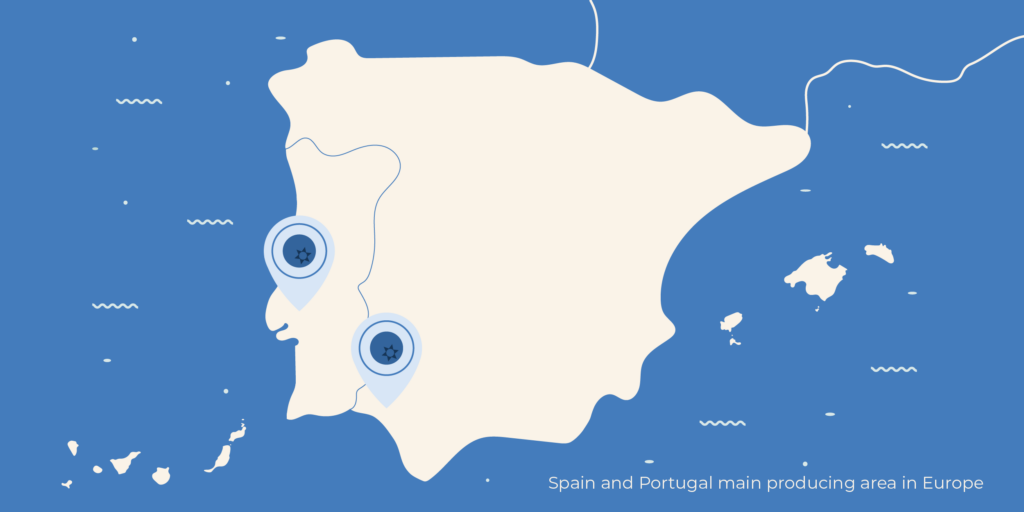
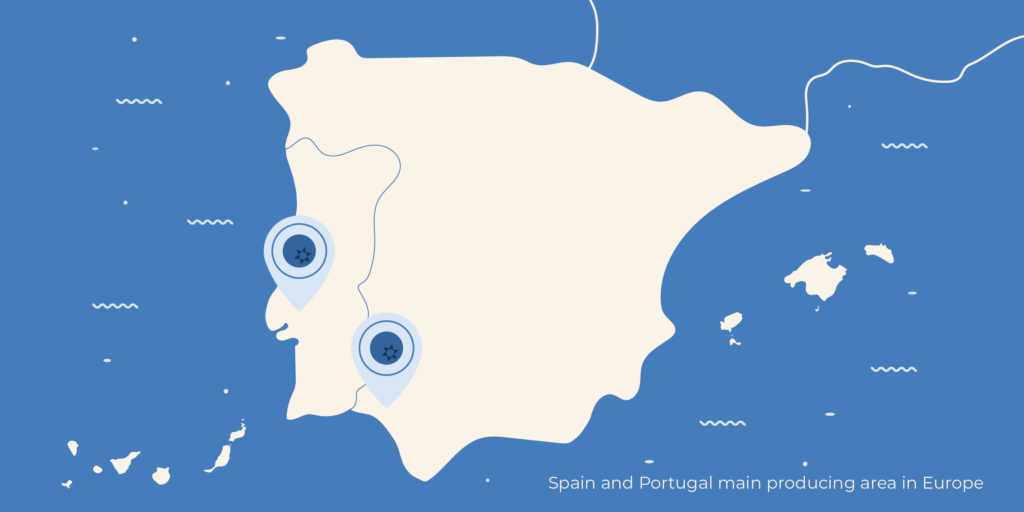
Blueberry cultivation has developed in southern Spain and Portugal since the 1970s, to the point where it is now the main producing area in Europe, with 42% of production (Eurostat, 2019). This boom is mainly due to two factors: increased demand and the climatic conditions in some regions of these countries.
The increase in consumption of blueberries in the EU has encouraged their production in areas that were not traditionally dedicated to their cultivation. Such is the case that Spain exported 25,000 tonnes to Germany alone in 2020, while Germany produced 14,800 tonnes. That is because in the last decade, there has been an increase in demand which cannot be domestically satisfied. In 2021, for example, only 16% of the blueberries consumed in Germany were also produced in Germany. This meant imports not only from Spain, but also from overseas countries such as Peru and Chile.
The greenhouse issue
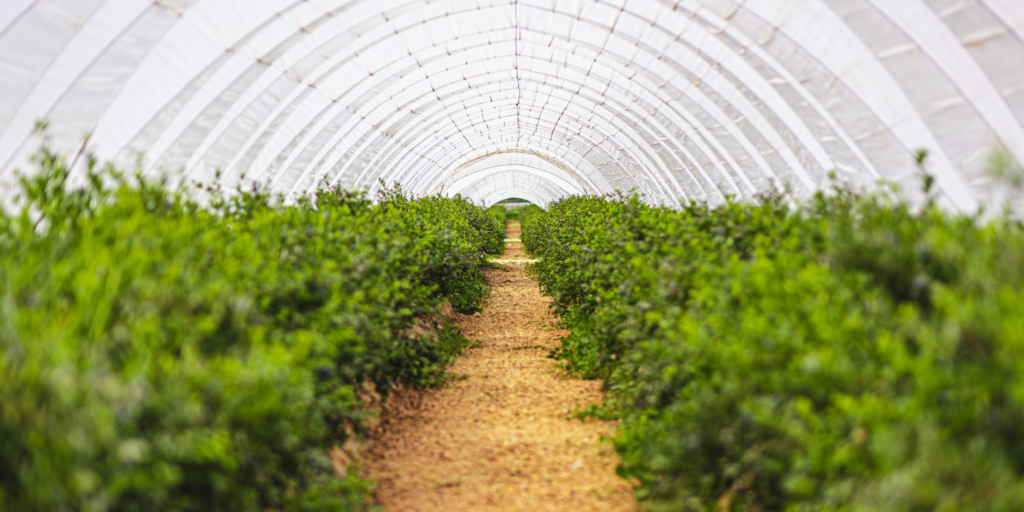
In 2022 around 80% of blueberries sold in Germany were imported – in many other European countries this figure is much higher, leading a tiny fruit to leave a big footprint. To meet the rising demand of the past years, blueberry production in Europe has increased significantly, also thanks to the use of new technologies and greenhouses. At CrowdFarming, one of the two producers selling blueberries through our platform – a German and a Spanish one – also grows their fruit in a passive solar greenhouse (while the German one grows his fruit outdoors).
First of all, it is important to distinguish between passive solar greenhouses and conventionally designed greenhouses, which use outside energy sources to provide heating and cooling (and thus further increase their environmental footprint).
According to studies we did on the topic with a specialised consultancy, if instead of growing the demand for blueberries in European countries we were to import them from other regions such as South America, where they are grown (less and less) without greenhouses, the carbon emissions emitted per kilo of blueberries consumed would be 2030% higher than those of CrowdFarming’s Spanish blueberries.
Another factor in favour of growing blueberries under glass in certain cases is the improved productivity per hectare cultivated and the reduction of inputs. Blueberries are delicate plants with fragile roots that are very sensible to environmental factors. Growing them in greenhouses has the advantage of providing a controlled environment, which in turn enables producers to successfully grow large quantities using less agrochemicals. Another upside is that the higher planting density requires less land use than if you were to grow the same quantity outdoors.
The water & climate issue
In the South of Europe there are exceptional climatic conditions in areas such as the Spanish province of Huelva, where one of our farmers is located: Sufficient hours of cold for the development of the blueberry bushes, paired with well-drained soils that prevent the waterlogging that is so detrimental to its cultivation, and historically abundant rainfall to supply the plant’s water requirements.
However, there is a limiting factor in this region that farmers have had to face: the high temperatures of the summer season damage the fruit and make it impossible to obtain an adequate quality for commercialization. For this reason, harvesting was brought forward to cooler months, such as April and May, and varieties adapted to less cold and humid climates were selected, helping to ensure that their water needs are lower than those required during the summer, thus saving a significant amount of water.
For this purpose, passive solar greenhouses – those used merely for protection and not artificially heated – are used to protect the plants from the harsh winter weather. Their use is also associated with several additional benefits, such as avoiding part of the plants’ evapotranspiration, conserving water in the soil and favouring pest control. It should be specified that this form of protected cultivation is not limited to these southern European areas, but is also on the rise in the original producer countries, as it provides farmers with guarantees that their crops will not suffer in the winter months and thus improve productivity.
The plastic waste issue
We cannot ignore the repercussions derived from the use of greenhouses, such as the plastic waste they generate. CrowdFarming together with the producers who work with the platform, try to ensure that the greenhouses are properly managed according to regional legislation, through authorized managers. The materials are used as much as possible, being able to optimize the useful life of the greenhouses for up to five years.
According to the farmers association APROA over 90% of the solar greenhouses in Spain are recycled once they have completed their 5-year life cycle. Around 80% of the resulting recycled plastic is reused to make containers, street furniture, bags and other utensils, or so they claim. That being said, there are still too many producers that do not properly dispose of their plastic waste, either by dumping it somewhere instead of bringing it to official recycling centers or by burning it. Oftentimes the plastic waste resulting from greenhouses is also too dirty or degraded which makes it harder to recycle. That is why we only work with farmers who comply with official requirements for the management of their waste.
Requirements for CrowdFarming blueberry projects:
From CrowdFarming we supervise a series of good practices to be carried out by berry farmers, which are essential for their farms to become part of our community. Among these we highlight:
- Equipment to record climate (environmental management) and soil (irrigation management) metrics for rational decision making
- Authorisation for the abstraction of water for irrigation of the crop
- Proof of delivery of plastic waste of agricultural origin to an authorised waste manager
- Crops not grown in hydroponic or soilless production systems
- Organic production certification according to RCE 834/2007 – European Certification or similar
- No heating systems in the greenhouses
- Farms may not be located in the area surrounding the Doñana National Park
The main issue with blueberry production is an old acquaintance: the workings of the traditional food supply chain. Demand exceeds supply, and while in Southern Europe we have the conditions to supply blueberries to meet the demand generated in the months when the blueberries cultivated outdoors in countries such as Germany are not yet ready to harvest, wanting to eat blueberries all year long automatically implies overseas imports. This means long distance transport and, even if the fruit is organic, it is produced under different labour regulations than those established in the EU. And: While it is recommendable to buy fruits produced in the European Union and greenhouse production might be a good option to ensure local supply, it is imperative that we do not defend any and all types of production: Greenhouses must not be heated, they must be geared towards reducing water consumption and the plastic used needs to be replaced as sparingly as possible and disposed of through an authorized waste management facility. Only then can they become an aid in the fight to make blueberry production more sustainable.
Written by Javier Ruiz

Farmer Analyst Javier estudió Ciencias Ambientales en la Universidad de Málaga, y desde entonces ha dedicado su carrera profesional a la sostenibilidad agrícola, y anteriormente a sistemas de transporte urbanos. Es Master Executive en Desarrollo Sostenible y Responsabilidad Corporativa por la EOI.
Keep digging ...