

Published August 2026
The infinite range of apple varieties
With an estimated 30,000 different varieties worldwide, the sheer diversity of apples is overwhelming. But why is there such a great number of varieties among apples, of all things? The answer is relatively obvious: the wild apple comes from the Caucasus and parts of Asia and was domesticated there thousands of years ago. The journey to Europe was also relatively short, and so the Romans were already cultivating different apple varieties in the 6th century BC. Until today, the apple has lost none of its popularity and has therefore had a lot of time to be selected into the most versatile varieties.
Even though the selection of apples in many supermarkets still seems huge today, of the thousands of different varieties, only about 25 are cultivated in commercial orchards and even fewer are regularly offered for sale. In the 1970s, there was a standardisation in fruit growing towards high-yielding and easy-to-care-for apple trees that produce apples that are as uniform and tasty as possible. The new varieties are usually sweeter than the old ones. Many old varieties thus fell into oblivion. For some years now, however, the old tart to slightly tart apple varieties have been found again in isolated cases at farmers’ markets and in organic food shops.
Old apple varieties
Among the old apple varieties are all those that originated before the middle of the 20th century. There was no deliberate cross-breeding in fruit growing at that time, and the different apple varieties emerged from cross-breeding that occurred by chance. The old varieties are gaining popularity again today due to their diverse flavours and usage characteristics. Old varieties are also interesting for apple allergy sufferers because they are usually better tolerated.
One of these old and now hardly known varieties is Kronprinz Rudolf. Discovered in Styria in 1860, it was one of the most important varieties in Austria for decades. Due to its pressure-sensitive skin, however, it is not suitable for mechanical harvesting and sorting and is therefore very rarely grown today. The medium-sized, flat-round apples have a shiny, light yellow skin that is bright red on the sunny side. The tender white pulp is juicy and tart.
However, there are also some old apple varieties that are still widely grown and popular. These include the Golden Delicious, Granny Smith and Gala varieties.
- Golden Delicious, as the name suggests, is yellow and very tasty. Probably discovered in the USA around 1890, it quickly spread around the world and is now one of the most important green-yellow varieties. Because of its firm texture and sweetness, it is suitable for almost all types of recipes.
- The Granny Smith is known for its crisp and bright green skin and its tart, juicy flavour. It was discovered by Maria Ann Smith (Granny Smith) in Australia in 1868. The Beatles made this apple a star when they chose it as the symbol of their “Apple Records” label.
- The well-known Gala variety was also discovered in the Southern Hemisphere. It was accidentally bred in New Zealand in the 1930s from a cross between Kidds Orange and Golden Delicious. In the supermarkets, however, one more often finds the more strongly coloured related variety Gala Royal.
Most popular apple varieties
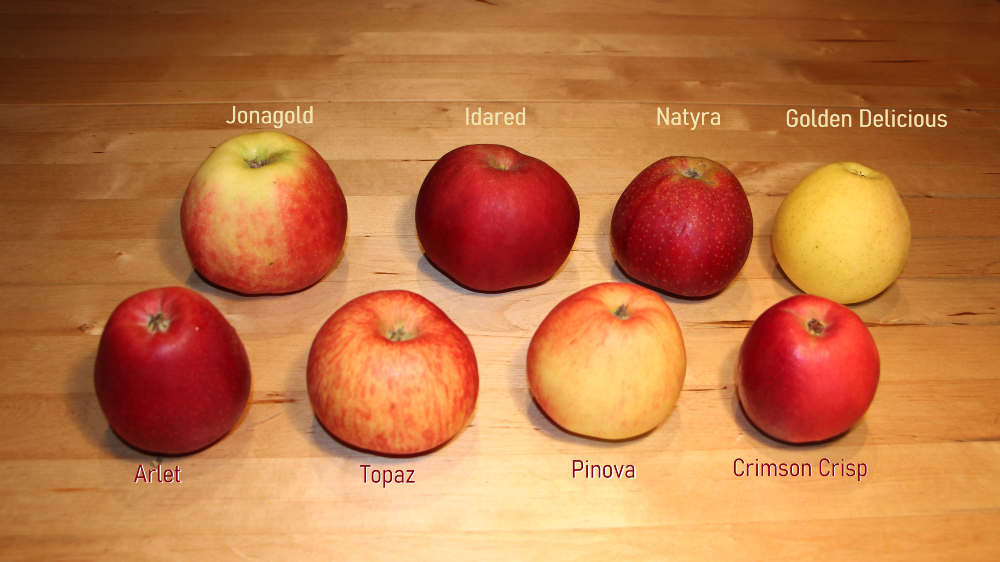
Besides Golden Delicious, the most popular and most commonly grown varieties include the somewhat younger varieties Elstar, Jonagold, Braeburn, Idared, Pinova, Topaz and Fuji.
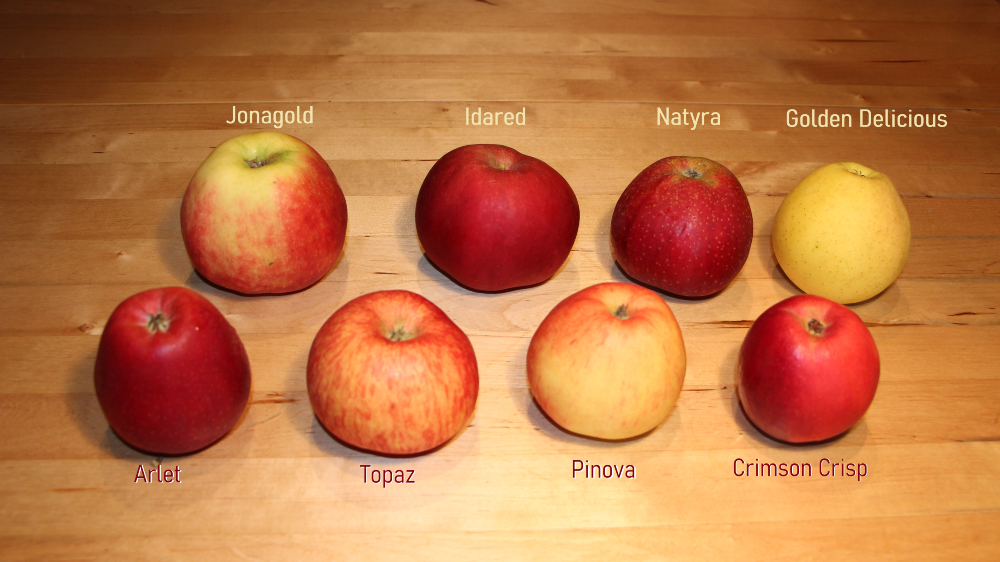
The two red-yellow varieties Elstar and Braeburn date back to the 1950s and are popular for their juicy and slightly sour taste. Both varieties are suitable for eating fresh as well as for baking or making juice and apple sauce. While the crisp Elstar was bred in the Netherlands and is now the most commonly grown variety in Germany, Braeburn was discovered by chance in New Zealand and is now one of the most important varieties of apple growing there.
The red Fuji is a popular dessert apple for its sweetness and crunchiness and is the most widely grown variety in the world, especially in China. It was bred in Japan in the late 1930s.
Especially in the northern growing regions, the red-yellow to bright-red Jonagold variety is often found. It has a yellowish and juicy pulp and is particularly suitable as a dessert apple due to its balanced sweet-fruity to slightly sour taste. It was bred in the 1940s in the USA, where the Idared variety was also developed at almost the same time. This variety, which is also yellow-red, has a rather mild flavour and is characterised by a good storage life.
The German variety Pinova and the Czech variety Topaz are particularly crunchy and aromatic-fruity varieties and are not only suitable for direct consumption, but also for baking and cooking. Both have a red-yellow skin with pretty stripes. The modern variety Red Prince, also called Red Jonagold, is also becoming increasingly popular. It is bright dark red and impressively sweet and crunchy.
New apple varieties
In the meantime, apple varieties are no longer bred only for their taste, but primarily for certain characteristics, such as resistance to diseases. Through targeted breeding, natural resistance to pests and diseases can be strengthened. These resistances are particularly important in growing organic crops, as no synthetic pesticides can be used. Adaptability to changing climatic conditions is also becoming increasingly important when breeding new varieties.
These resistant varieties, which are particularly suitable for organic farming, include Natyra and Choupette. The red-yellow Natyra is specially bred for organic farming and is somewhat sweet and tart at the same time. The French variety Choupette Bio is a popular organic variety in France due to its resistance to diseases and fungi. Like many modern varieties, it is also very sweet and has a pleasant tartness.
However, modern varieties are not only bred for health, other aspects are also important in our time. The Santana, for example, is particularly allergy-friendly. A special protein in the apple triggers the allergy. Varieties like Santana, as well as most old apple varieties, do not produce this protein. This means that they can also be eaten by people who are actually allergic to apples. The disadvantage of the old apple varieties for many people, however, is that they are usually more tart than the modern varieties. The Santana variety combines the hardiness needed for organic cultivation with good tolerance for allergy sufferers. However, the yellow-green to red apple is somewhat more acidic than the Elise variety.
Which variety to use for apple pie?
If you want to bake with apples, certain characteristics are required. The fruits must not lose their aroma and juiciness during baking. Some apple varieties even develop their full potential only during baking. Firm pulp and a sweet and tart taste are required. Some of the most popular varieties for baking that have these characteristics are:
- Braeburn
- Elstar
- Granny Smith
- Jonagold
- Red Prince
- Fuji
- Gala
Written by Linda Horbach

Keep digging ...